
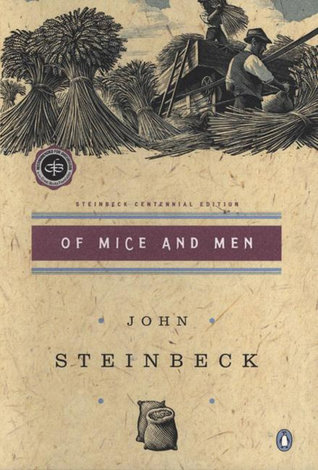
John Steinbeck’s Of Mice and Men is a deceptively small book with the moral weight of a tragedy. Its scale is intimate—two migrant labourers, a few days on a ranch, a single dream repeated like a prayer—yet its implications are expansive, reaching outward to the economic desperation of the Great Depression, the fragility of masculine identity, the loneliness of the dispossessed, and the cruel tenderness of hope itself. What makes the novella enduring is not simply that it tells a sad story, but that it renders suffering with such structural precision that the ending feels less like a surprise than an inevitability built into the world of the book.
The author’s prose is admirably spare. He writes in a style that looks plain on the surface but is carefully patterned underneath, full of recurring images, foreshadowing, and symbolic detail. The opening description of the Salinas Riverbank establishes this immediately: nature is lush, but it is also unstable, a place of shelter and threat at once. That doubleness becomes one of the novella’s governing principles. The ranch, too, is a paradoxical space: it offers work, but not belonging; motion, but not freedom; companionship in theory, isolation in practice. The men who inhabit it are economically connected and emotionally severed.
At the centre of the novella is the friendship between George and Lennie, one of the most moving partnerships in American fiction precisely because it is so unusual in Steinbeck’s world. George’s statement that “Guys like us, that work on ranches, are the loneliest guys in the world” captures the social reality of itinerant labour, but it also frames the novella’s ethical argument: human beings need one another, and the absence of durable companionship is not merely sad, but dehumanizing. George and Lennie’s bond is not idealized; it is burdened by responsibility, irritation, repetition, and fear. Yet Steinbeck presents it as a radical act of resistance against the atomization of ranch life. Their shared dream of a small farm is less an economic plan than a moral imagination, a way of insisting that life might contain stability, autonomy, and care.
That dream is among the novella’s most important devices. The story allows it to function simultaneously as fantasy, consolation, and critique. The farm Lennie asks to hear about again and again is not just a future property; it is a verbal refuge from a world in which men are always temporary, always replaceable, always one pay envelope away from the road. The repetition of the dream gives the novella its emotional rhythm, and its eventual collapse exposes the cruelty of hope in a world structured to deny it. Candy’s attachment to the dream deepens this theme. His hope is poignant because it arrives too late; he recognizes that the dream’s appeal lies in its promise of ownership, dignity, and a place where one is not discarded.
Steinbeck’s secondary characters sharpen the novella’s social vision. Crooks, isolated by racism, articulates one of the book’s harshest truths when he observes the psychological violence of exclusion. Curley’s wife, often reduced by the men around her to a temptation or threat, is given a tragic dimension that complicates the ranch’s masculine economy. Her loneliness is not incidental; it is structurally produced. The men on the ranch misread her because they cannot see how thoroughly she has been trapped by the same system that traps them, though in a different form. Even Curley, with his aggression and insecurity, is less a villain in the melodramatic sense than an emblem of social damage: the need to dominate others because one’s own status feels unstable.
The novella’s tragic force lies in its refusal of sentimentality. Steinbeck does not pretend that kindness is enough to save the vulnerable from a harsh world. And yet the book is not nihilistic. Its deepest sorrow comes from the fact that decency exists, but insufficiently protected by institutions or social arrangements. George’s final act is devastating because it fuses mercy, love, and unbearable necessity. In the last pages, the dream is not merely lost; it is preserved in memory at the moment of its destruction, which makes the ending feel both brutal and strangely sacred.
Of Mice and Men remains powerful because it understands that the smallest human hopes can bear the largest social meanings. It is a novella about the loneliness of labor, but also about the imagination of fellowship; about power, but also about tenderness; about inevitable loss, but also about the dignity of caring for another person even when the world gives almost no room for care. Steinbeck’s achievement is to make that dignity visible without ever softening the hard contours of the world that threatens it.
Discover more from The New Renaissance Mindset
Subscribe to get the latest posts sent to your email.
 The New Renaissance Mindset