
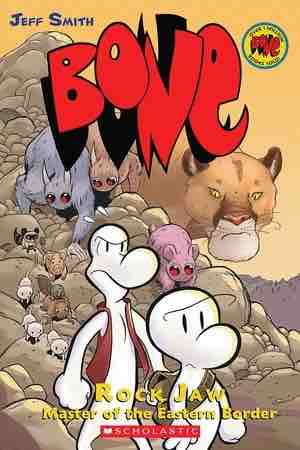
Jeff Smith’s Bone, Vol. 5: Rock Jaw, Master of the Eastern Border is the series at its most adventurous and, at the same time, one of its most morally alert instalments. What first seems like a comic detour into wilderness peril becomes, on closer reading, a sharp meditation on power, hierarchy, and the uneasy alliance between comic-book exuberance and mythic seriousness. This volume deepens the saga not by enlarging the stakes in a merely epic sense, but by making the landscape itself feel politically charged: the forest, the borderlands, and the mountains all become arenas in which competing forms of authority struggle for dominance.
At the centre of the volume stands Rock Jaw, a creature who is less a simple monster than a force of law. Smith presents him as the embodiment of territorial sovereignty, a figure who rules by fear and by a brutally coherent sense of place. His presence gives the book a heavier, more archaic atmosphere than earlier volumes. The title’s promise of mastery is not ironic. Rock Jaw is truly a master, but his mastery is destructive, absolute, and isolating. He is strongest when the terrain itself seems to conspire with him. In that sense, he resembles one of those elemental antagonists from myth who do not merely oppose the hero but define the terms of the world the hero must cross.
What is especially impressive is the way the Smith balances this menace with comedy and warmth. The Bone cousins remain wonderfully distinct: Fone Bone’s sincerity, Phoney Bone’s opportunism, and Smiley’s absurd elasticity create a rhythm that prevents the book from hardening into grimness. The dialogue is deceptively simple, but it has remarkable tonal range. A small exchange can pivot from slapstick to dread in a single panel, and that flexibility is one of the series’ great strengths. Even in the middle of danger, the characters continue to feel like themselves, which gives the peril emotional credibility. Their smallness against the vast borderland makes them vulnerable, but also human.
Thematically, Rock Jaw is one of the clearest demonstrations of the writer’s interest in borders—not only geographical ones, but moral and imaginative boundaries as well. The eastern border is a place of transition, but also of exclusion. The book repeatedly suggests that to cross into another domain is to enter another logic of life. This gives the volume a subtle philosophical dimension. Power here is not abstract; it is local, embodied, and tied to claims of ownership. Rock Jaw’s rule is a parody of order, a kingdom built on the threat of force. Against him, Smith places not a conquering hero but cooperation, endurance, and improvisation. That choice matters. The book refuses the fantasy that violence can be met with a cleaner, better violence. Instead, it privileges wit, solidarity, and survival.
Visually, Smith’s storytelling is among the volume’s finest achievements. His line work keeps the world buoyant and readable, even when the action becomes tense. The expressive faces, wide compositions, and carefully paced sequences give the book a cinematic clarity, but never at the expense of intimacy. The forested spaces feel alive, and the quieter panels have real resonance. Smith knows how to make a pause carry meaning. That control of rhythm is what allows the book to feel simultaneously playful and epic.
As a whole, Rock Jaw, Master of the Eastern Border strengthens the larger Bone cycle by proving that whimsy and seriousness are not opposites. Smith is building a world where comedy can coexist with myth, and where a monstrous border guardian can reveal something essential about authority itself. The volume’s accomplishment lies in that doubleness: it is a thrilling adventure story, but also a reflection on what it means to belong to a place, to resist domination, and to remain oneself under pressure. In the long architecture of Bone, this book stands as one of the most elegant crossings between childhood wonder and literary depth.
Discover more from The New Renaissance Mindset
Subscribe to get the latest posts sent to your email.
 The New Renaissance Mindset