
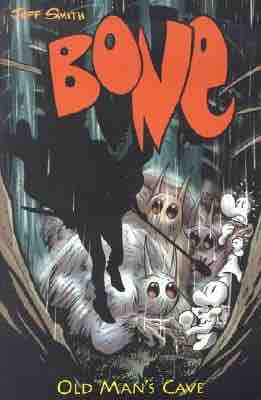
With Old Man’s Cave, Jeff Smith deepens Bone’s strange alchemy of pastoral comedy, epic fantasy, and uncanny menace. What has gradually become clear by this sixth volume is that the author is not merely telling a children’s adventure story that happens to grow darker over time; he is building a mythic world in which humour, dread, and tenderness are inseparable. This instalment intensifies that balance. The result is a book that feels both nimble and ominous, light on its feet yet shadowed by forces far older and larger than any of its characters.
One of the volume’s great strengths is its control of tonal contrast. It can move from playful banter to genuine peril without fracturing the narrative’s emotional logic. That matters because Bone has always relied on the reader’s willingness to accept tonal instability as a feature rather than a flaw. In Old Man’s Cave, the jokes are not a distraction from the story’s seriousness; they are part of its structure. The comic rhythms make the danger more vivid, and the danger in turn lends the comedy a tremor of fragility. The world feels lived in because it refuses to stay in one register for long.
At the centre of the volume is the continuing development of Fone Bone, whose moral clarity remains one of the series’ quiet achievements. He is not “heroic” in the conventional sense. He is earnest, frightened, loyal, and often overmatched. Yet that very modesty gives him force. Smith uses Fone Bone as a kind of ethical compass in a world where power is frequently tied to deception, appetite, and illusion. Against the volume’s growing sense of historical burden, Fone Bone’s decency reads not as naïveté but as resistance. He is one of the rare fantasy protagonists whose goodness is not a superpower but a discipline.
The title itself, Old Man’s Cave, signals one of the book’s central concerns: the past as an enclosed, half-buried space that still exerts pressure on the present. Smith repeatedly suggests that history in this series is not a distant backdrop but an active environment. The cave becomes more than a setting; it is an image of memory, secrecy, and inheritance. Like much of Bone, it evokes the idea that the landscape itself remembers. Characters move through it as if through an archive of unresolved violence. In that sense, the volume’s fantasy geography is also psychological geography.
The comic artist’s visual storytelling continues to be one of the series’ great pleasures. His line-work is supple and expressive, capable of shifting from cartoon exuberance to eerie stillness with remarkable ease. He trusts gesture, silhouette, and pacing. Whole emotional transitions can happen across a panel or two. The reader does not simply receive information; the reader is made to feel the rhythm of discovery and alarm. This is especially effective in sequences where characters confront hidden spaces or ambiguous presences. Smith understands that suspense in comics depends not only on what is shown, but on how the eye is guided from image to image, from expectation to revelation.
Another of the volume’s notable qualities is its expanding sense of moral complexity. The forces at work in Bone are never reducible to simple good and evil, and Old Man’s Cave sharpens that ambiguity. Threat is often wrapped in seduction. Power presents itself as destiny. Characters are tempted to believe that they are participating in a story that has already been written for them. Smith resists that fatalism. Even as the mythic machinery grows more elaborate, he keeps insisting on choice, responsibility, and consequence. The result is a fantasy that feels less escapist than interpretive: it asks what kinds of people we become when we are forced to live under inherited narratives.
What makes Old Man’s Cave especially strong is that it advances the series without abandoning its openness to wonder. The book never becomes grim for the sake of grimness. Instead, it lets mystery remain mysterious. That restraint is crucial. Smith knows that the deepest enchantments are often the least explained ones. By leaving room for uncertainty, he preserves the reader’s sense that the world is larger than the plot. Few fantasy comics achieve that without losing momentum.
Ultimately, Bone, Vol. 6: Old Man’s Cave stands as a fine example of serialized storytelling that is both cumulative and self-renewing. It enriches the larger arc while functioning as a compelling chapter in its own right. More importantly, it reveals Jeff Smith’s rare gift for making a comic feel simultaneously accessible and mythologically resonant. The volume is funny, tense, and beautifully paced, but its deepest achievement lies elsewhere: it persuades us that even in a world of monsters, prophecy, and hidden caves, character still matters most.
Discover more from The New Renaissance Mindset
Subscribe to get the latest posts sent to your email.
 The New Renaissance Mindset