
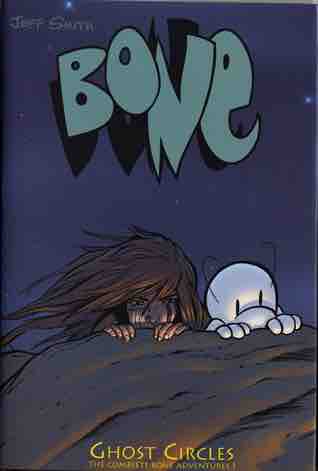
Jeff Smith’s Bone, Vol. 7: Ghost Circles is one of the series’ most haunting achievements (no pun intended), a volume in which the fantasy adventure grows stranger, darker, and more inward-looking without losing its wit or momentum. What makes the book so compelling is that it does not simply escalate the plot; it deepens the atmosphere. The valley is no longer just a stage for comic peril and mythic pursuit. It becomes a place where memory, fear, and enchantment blur into one another, as though the land itself were remembering older wounds.
At the centre of the volume is the eerie idea of the “ghost circles,” those supernatural zones where the ordinary laws of the world are warped or suspended. Smith uses them not merely as a plot device, but as a literary emblem. They externalize the emotional disorientation that has been gathering across the series: the characters are not only trying to survive danger, they are trying to understand what kind of world they inhabit. In that sense, the ghost circles function like a visual metaphor for instability itself. They suggest that reality in Bone is never solid for long, and that beneath the surface of comedy and quest narrative lies something ancient, unsettled, and fearful.
This volume is especially strong in its tonal control. The author balances the grotesque and the whimsical with remarkable precision. A scene can begin in near-fairy-tale simplicity and end in uncanny menace. That oscillation is part of the book’s power: laughter never fully cancels dread, and dread never erases tenderness. The result is a world that feels alive because it is internally contradictory. Even the more playful moments carry undertones of loss, while the most frightening passages are haunted by absurdity.
One of Smith’s great virtues as a storyteller is his refusal to flatten his characters into functions of the plot. In Ghost Circles, their reactions to the valley’s strangeness reveal as much about them as the dangers themselves. Fone Bone’s decency, for instance, remains a stabilizing moral center, but it is tested by uncertainty rather than rewarded by clarity. Thorn’s growing awareness of her own place in the larger mythology gives the volume real dramatic force, because her identity is no longer merely something to be discovered; it is something that seems to be unfolding under pressure. Even the supporting figures are drawn with enough personality to make the world feel populous rather than merely populated.
Smith’s art is crucial to the novel’s effect. His line work can turn a panel from open, humorous clarity into dense visual unease with almost no warning. He understands pacing in a deeply literary way. Pages do not simply advance the action; they modulate suspense. The use of shadow, spatial distortion, and repeated visual motifs gives the volume a dream logic that suits its subject perfectly. The ghost circles are not only described; they are felt in the structure of the page.
If the earlier volumes of Bone sometimes leaned more heavily on the pleasures of adventure and comic relief, Ghost Circles marks a maturation of the series into something more ambitious. It is still accessible, still fast-moving, still funny, but it now carries the weight of a fable about perception, inheritance, and the instability of the real. Smith seems increasingly interested in the way stories themselves create zones of uncertainty: once characters cross into myth, they may not return unchanged.
The book’s achievement, then, is not simply that it entertains, but that it alters the reader’s sense of the whole series. It widens the emotional and symbolic field. By the end, the valley feels less like a setting than a living pressure system of memory and fate. Ghost Circles is a reminder that fantasy can be playful without being shallow, and that children’s literature, in the hands of a serious artist, can carry real metaphysical unease.
What lingers most is the atmosphere: that sense of being watched by the past, of moving through a world where the ground may not be trustworthy, and where every strange threshold opens onto another, stranger one. Jeff Smith gives us adventure, yes, but also a meditation on instability, and that is what makes this volume so memorable.
Discover more from The New Renaissance Mindset
Subscribe to get the latest posts sent to your email.
 The New Renaissance Mindset