
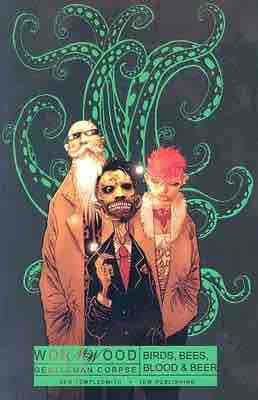
Wormwood: Gentleman Corpse, Vol. 1: Birds, Bees, Blood & Beer is one of those comics that understands a crucial truth of horror-comedy: the grotesque works best when it smiles back at you. Collected here from the first miniseries plus the original “Taster” issue, the book arrived in 2007 as a 152-page, creator-owned burst of fully authored excess, with Ben Templesmith handling the writing, art, and design. Its setup is gloriously unholy: “things are awakening in the city,” bodies are dropping, and Wormwood—described in review copy as a “preternaturally cheery corpse”—lurches into the mess alongside the robot sidekick Mr. Pendulum and the punkish Phoebe.
What gives the volume its sting is that it never treats shock as an end in itself. Publishers Weekly’s assessment is exactly right: what could have been “rank” or “derivative” instead “tweaks a surprising amount of humour” from familiar occult pulp, while cloaking the whole thing in “darkly layered and intricate art.” That combination is the book’s real achievement. It feels like a demon story filtered through nightclub smoke, cheap beer, and gallows wit—less a straight narrative than a nocturnal attitude. Wormwood is not a psychologically subtle hero, but he does not need to be; he is a swaggering emblem of appetite, vanity, and blasphemous charm, a figure who turns every scene into a bar-room apotheosis of bad manners.
The title itself, Birds, Bees, Blood & Beer, is a neat little manifesto. “Birds and bees” suggests the usual rites of human instruction; “blood and beer” yanks that innocence into the gutter, where the author prefers to stage his drama. The book’s pleasure lies in that collision: the juvenile joke, the visceral image, the occult threat, and the deadpan punchline all occupying the same panel-space. As a debut volume, it is more swagger than depth, more fever dream than metaphysical inquiry, but that is precisely why it works. It is a comic that knows how to make rot feel lively, and it makes that liveliness contagious.
In literary terms, this is not merely a monster comic; it is a comic about style as survival. Templesmith’s world is one where corruption is everywhere, yet the line-work, pacing, and bitterly comic voice transform decay into performance. The result is memorable not because it cleanses horror, but because it revels in its mess and still manages elegance. For readers who like their supernatural fiction rude, inventive, and visually haunted, this volume is a dark delight.
Discover more from The New Renaissance Mindset
Subscribe to get the latest posts sent to your email.
 The New Renaissance Mindset