
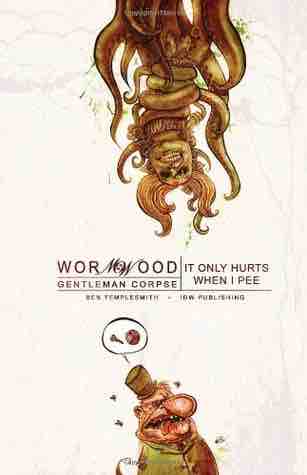
Wormwood: Gentleman Corpse, Vol. 2: It Only Hurts When I Pee is a deliciously deranged exercise in comic-book grotesquerie, but it is not merely a string of jokes dressed up in slime and tentacles. The collected edition runs 120 pages and sends Wormwood and his companions into Lephrechaunia to find the Leprechaun Queen, the only being capable of lifting the “terminal curse” he has contracted after a leprechaun bite. That setup alone tells you the volume’s governing intelligence: Templesmith is not chasing realism, but escalation—each absurd premise is pushed until it becomes strangely coherent. Even the publisher’s synopsis reads like a manifesto of excess: “sublime lunacy,” “rabid leprechauns,” and a “terrifying collective” bent on “ingest[ing] everything they can get their tentacles on.”
What makes the book more than a novelty is the way its comedy turns bodily humiliation into existential threat. The title, It Only Hurts When I Pee, sounds like a gross-out punchline, but in context it becomes a miniature philosophy of Wormwood’s condition: the body is both joke and prison, joke and death sentence. The author’s brilliance is that he never lets the reader settle into one register for long. “Rabid leprechauns” might invite laughter on one page, yet they also reveal the book’s deeper obsession with contagion, appetite, and corruption. The humour is bawdy, even juvenile at times, but it is also precise; it understands that disgust is funniest when it is inseparable from dread.
As a piece of visual storytelling, the volume’s strength lies in its willingness to treat monstrosity as texture rather than exception. Wormwood’s world is built from collisions: folklore collides with body horror, inter-dimensional travel collides with barroom vulgarity, and myth collides with the ordinary shame of a body in trouble. The result is a comic that feels less like a conventional plot than a fevered folklore machine, where every strange image seems to generate the next. Even in synopsis form, the book announces itself as a work of controlled chaos; in practice, that chaos is what gives it style.
My reading is that this volume succeeds because it trusts contradiction. It is filthy but elegant, stupid on the surface but cunning in structure, and gleefully irreverent without losing narrative momentum. For readers who like horror that laughs at its own wounds, this is exactly the sort of comic that lingers: not because it is tidy, but because it is so committed to being gloriously untidy.
Discover more from The New Renaissance Mindset
Subscribe to get the latest posts sent to your email.
 The New Renaissance Mindset