
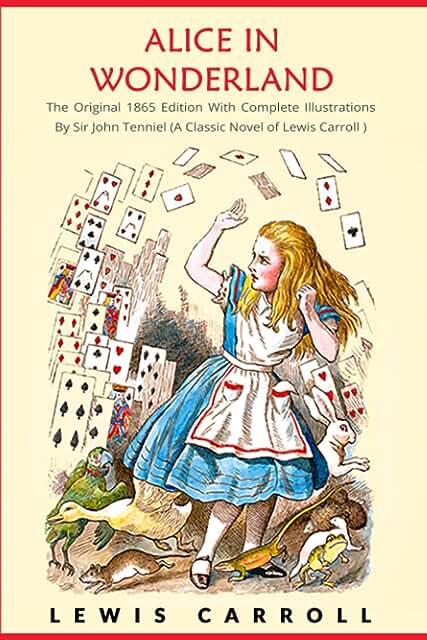
“Alice’s Adventures in Wonderland” (Lewis Carroll, 1865) tells the story of a young girl named Alice who falls through a rabbit hole into a fantastical world filled with peculiar creatures and bizarre adventures. The narrative begins with Alice, bored and restless, sitting by her sister. She spots a White Rabbit dressed in a waistcoat and obsessively checking his pocket watch. Curiosity leads her to follow him down a rabbit hole, where she encounters a series of strange and whimsical characters, such as the Cheshire Cat, the Mad Hatter, the Queen of Hearts, and the Caterpillar. The story unfolds as Alice navigates this topsy-turvy world, growing and shrinking in size and trying to make sense of the nonsensical rules that govern Wonderland.
Themes
- Curiosity and Exploration: Alice’s journey is driven by her insatiable curiosity. Her willingness to follow the White Rabbit and explore Wonderland exemplifies the theme of curiosity, a fundamental aspect of childhood.
- Absurdity and Nonsense: The book is renowned for its embrace of absurdity and nonsensical elements. Characters speak in riddles and engage in illogical behavior, challenging traditional narrative structures and highlighting the whimsical nature of Wonderland.
- Identity and Growth: Alice’s frequent changes in size symbolize her fluctuating sense of self. Her journey through Wonderland can be seen as a metaphor for the process of growing up and finding one’s identity in a confusing and unpredictable world.
- Authority and Rebellion: The arbitrary and often tyrannical rules imposed by characters like the Queen of Hearts reflect a critique of authority. Alice’s interactions with these figures often involve questioning and rebelling against their nonsensical commands.
Characters
- Alice: The protagonist, a curious and adventurous young girl. Her logical approach to the illogical world of Wonderland provides much of the book’s humor and insight.
- The White Rabbit: A nervous and hurried creature who leads Alice into Wonderland. His obsession with time serves as a catalyst for the story.
- The Cheshire Cat: Known for his enigmatic grin, the Cheshire Cat provides cryptic advice and philosophical insights to Alice.
- The Mad Hatter: A tea party host trapped in a perpetual tea-time. His eccentric behavior and nonsensical conversation exemplify the book’s theme of madness.
- The Queen of Hearts: A tyrannical ruler obsessed with executing her subjects. She embodies the arbitrary nature of authority in Wonderland.
Literary Devices
- Wordplay and Puns: Carroll frequently uses wordplay to create humor and to challenge conventional language usage. For example, the Mad Hatter’s tea party is filled with puns and linguistic absurdities.
- Symbolism: Many elements in Wonderland serve as symbols for broader concepts. Alice’s size changes can be interpreted as symbolic of her fluctuating sense of self and the challenges of growing up.
- Satire: Carroll satirizes Victorian society and its conventions through the characters and their absurd behaviors. The mock trial at the end of the book, for instance, critiques the legal system.
Analysis
Lewis Carroll’s “Alice’s Adventures in Wonderland” is a pioneering work in the genre of literary nonsense, challenging traditional narrative forms and linguistic conventions. The book’s enduring appeal lies in its ability to engage readers of all ages with its playful language, imaginative world-building, and philosophical undertones. Alice’s journey through Wonderland can be seen as a reflection of the bewildering transition from childhood to adulthood, filled with its own set of perplexing rules and discoveries.
Carroll’s background as a mathematician is evident in the logical puzzles and paradoxes embedded within the story, which invite readers to question reality and embrace the joy of imagination. The characters Alice meets along her journey each represent different aspects of the human experience, from the existential musings of the Cheshire Cat to the chaotic rule of the Queen of Hearts.
In conclusion, “Alice’s Adventures in Wonderland” remains a seminal work in children’s literature and fantasy fiction. Its rich layers of meaning, coupled with its playful narrative style, ensure that it continues to captivate and inspire readers, inviting them to see the world through the eyes of a curious and fearless child.
Personal Reflection
Reading “Alice’s Adventures in Wonderland” is like stepping into a dream where the impossible becomes possible. The book encourages readers to question their assumptions and embrace the unknown with curiosity and courage. Alice’s adventures remind us that, much like Wonderland, life is filled with unexpected twists and turns that can lead to moments of profound insight and joy.
Discover more from The New Renaissance Mindset
Subscribe to get the latest posts sent to your email.
 The New Renaissance Mindset
My favourite book of all time, albeit I have many favourites…
LikeLiked by 1 person
Highly revolutionary work transforming children’s literature. And the second most quoted book in the English language. Profound cultural legacy.
LikeLiked by 1 person