
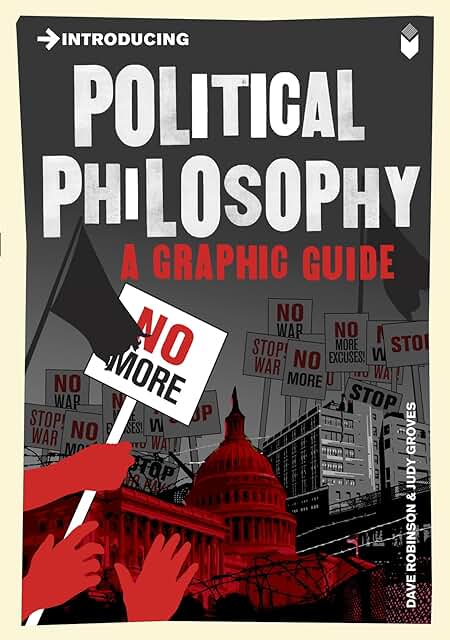
Title: Introducing Political Philosophy: A Graphic Guide
Authors: Dave Robinson, Illustrated by Judy Groves
Genre: Non-fiction, Philosophy, Political Science, Graphic Guide
Publication Year: 2012
Book Overview:
“Introducing Political Philosophy: A Graphic Guide” by Dave Robinson, with illustrations by Judy Groves, is an engaging and accessible introduction to the fundamental concepts and thinkers in political philosophy. The book is part of the “Introducing” series, known for using the graphic novel format to elucidate complex subjects. This particular volume adeptly combines text and illustrations to make the dense and often abstruse ideas of political philosophy understandable and engaging for a broad audience.
Content Summary:
The book covers a wide range of topics within political philosophy, spanning from ancient to contemporary thought. It begins with the early political theories of Plato and Aristotle, examining their ideas on justice, the role of the state, and the nature of political power. The narrative then moves through the contributions of key thinkers such as Thomas Hobbes, John Locke, Jean-Jacques Rousseau, Karl Marx, and John Stuart Mill.
Robinson not only presents the historical context in which these philosophers wrote but also explains their key arguments and the lasting impact of their ideas on modern political thought. For instance, Hobbes’ notion of the social contract and the justification of political authority is contrasted with Locke’s views on natural rights and government by consent. Rousseau’s concept of the general will is explored alongside Marx’s critique of capitalism and his vision for a classless society.
The guide also delves into 20th-century political philosophy, including the works of John Rawls, who is known for his theory of justice as fairness, and the critiques posed by libertarian and communitarian philosophers. The book touches on the practical applications of these theories, considering their relevance to contemporary issues such as democracy, freedom, equality, and justice.
Illustrations:
Judy Groves’ illustrations are integral to the book’s accessibility and appeal. The visual elements help to break down complex ideas into digestible segments, providing a visual shorthand that complements and clarifies the text. The illustrations are not merely decorative but serve as an essential tool for understanding, often using humor and metaphor to make abstract concepts more concrete.
Critical Analysis:
“Introducing Political Philosophy: A Graphic Guide” is commendable for its clarity and conciseness. Dave Robinson’s writing is both informative and engaging, making the subject matter approachable without sacrificing intellectual rigor. The book’s structure, which moves chronologically through the history of political thought, allows readers to see the development of ideas and how they influence each other.
One of the book’s strengths is its ability to link historical philosophical ideas to modern political issues, demonstrating the enduring relevance of political philosophy. The guide encourages readers to think critically about their own political beliefs and the philosophical foundations that underpin them.
However, the book’s brevity can also be a limitation. While it provides a broad overview, it cannot delve deeply into the intricacies of each philosopher’s work. Readers seeking a more comprehensive understanding might need to supplement this guide with more detailed texts.
Conclusion:
“Introducing Political Philosophy: A Graphic Guide” is an excellent starting point for anyone new to the field of political philosophy. Its combination of clear, concise writing and engaging illustrations makes it an ideal introduction for students and general readers alike. By presenting complex ideas in an accessible format, Robinson and Groves succeed in making political philosophy both interesting and relevant, inviting readers to explore the rich landscape of political thought further.
Recommendation:
I highly recommend this book to those who are interested in understanding the fundamental concepts of political philosophy without getting bogged down by dense academic prose. It is particularly useful for visual learners and those who appreciate a more interactive approach to studying philosophy. Whether you are a student, a casual reader, or someone with a burgeoning interest in political theory, “Introducing Political Philosophy: A Graphic Guide” offers a valuable and enjoyable reading experience.
Discover more from The New Renaissance Mindset
Subscribe to get the latest posts sent to your email.
 The New Renaissance Mindset