
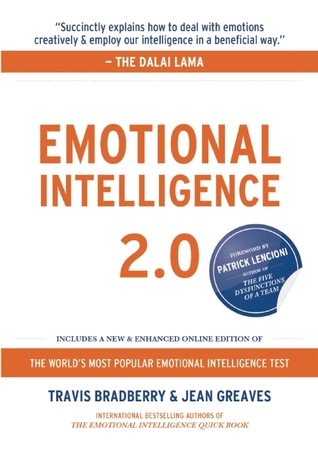
Emotional Intelligence 2.0, authored by Travis Bradberry and Jean Greaves, presents itself as a timely, accessible guide to understanding and improving emotional intelligence (EI) in an increasingly complex world. Drawing from the foundational work of Daniel Goleman, who popularized the term in the 1990s, Bradberry and Greaves endeavor to move EI from a theoretical framework to a pragmatic skill set that individuals can cultivate for personal and professional success. However, beneath the book’s simple structure lies a deeper dialogue about the human condition, the growing influence of self-awareness in modern society, and the commodification of emotional growth.
At the heart of Emotional Intelligence 2.0 is the notion that emotional intelligence can be measured and systematically improved, akin to learning a new language or mastering a musical instrument. The book is divided into four core components: self-awareness, self-management, social awareness, and relationship management. Each section offers practical strategies to heighten emotional competency, all structured around the core argument that increasing one’s EI directly correlates with improved life outcomes—better relationships, career advancements, and enhanced well-being.
From a literary perspective, the text adopts a highly utilitarian tone, prioritizing clarity over lyricism, and readability over introspection. The authors employ accessible language and straightforward examples, making the book palatable to a broad audience. This choice, while effective in conveying the message, comes at the cost of depth. For the reader seeking a profound exploration of the intricacies of human emotion, the text may seem overly simplified, as it often sidesteps more complex philosophical questions about emotional consciousness and the tension between self and society.
One of the most intriguing aspects of the book is its use of an online EQ test that readers can take to assess their emotional intelligence levels. This interactive element creates an immediate sense of involvement and personalization. However, the test’s emphasis on quantifying emotional intelligence reveals a key limitation: the reduction of an inherently fluid and subjective experience into a fixed score. In this regard, Bradberry and Greaves navigate the perilous terrain of reducing the human psyche to a metric, which raises questions about the limits of empirical analysis in the realm of emotional development.
The authors’ pragmatic approach is both a strength and a weakness. On the one hand, they provide actionable advice, making the book particularly useful for individuals in the business world who want to foster better leadership and teamwork through improved emotional awareness. On the other hand, their approach can at times feel prescriptive and formulaic, leaving little room for the nuances of emotional experience. Emotions, by their very nature, are unpredictable and multifaceted; while strategies like practicing mindfulness or increasing empathy are undoubtedly valuable, they may not fully capture the richness of emotional intelligence as a lived experience.
One of the book’s most compelling elements is its focus on self-management and self-awareness, which feels particularly resonant in the contemporary era of self-optimization. In a culture saturated with productivity tools and wellness trends, Emotional Intelligence 2.0 fits neatly into the genre of self-improvement literature. Yet, it also subtly critiques the very culture it serves by emphasizing the value of authentic emotional expression over mere efficiency. The authors’ repeated encouragement to “pause” and “reflect” signals a resistance to the frenetic pace of modern life, advocating instead for a more contemplative engagement with one’s emotional world.
However, a deeper analysis of the text raises the question: Can emotional intelligence be truly taught, or is it an innate quality that can only be refined? The book leans heavily on the notion that emotional intelligence is a skill, neglecting to fully explore the role of individual temperament, early life experiences, or the cultural influences that shape our emotional landscape. This oversight makes the text feel somewhat incomplete, as it fails to engage with the broader socio-psychological forces that influence emotional intelligence.
In conclusion, Emotional Intelligence 2.0 is a practical, easy-to-follow guide for anyone seeking to improve their emotional literacy and strengthen interpersonal relationships. While it excels in providing tools and strategies for immediate application, it leaves deeper, more existential questions about the nature of emotions and human connection largely unexplored. For readers seeking a hands-on approach to improving emotional intelligence, the book offers a clear, structured path. However, for those interested in the philosophical dimensions of emotional life, the book might serve more as a stepping stone than a destination. Bradberry and Greaves, in their mission to demystify emotional intelligence, succeed in offering practical guidance, but they may inadvertently oversimplify the rich, often ineffable complexity of human emotion.
Discover more from The New Renaissance Mindset
Subscribe to get the latest posts sent to your email.
 The New Renaissance Mindset