
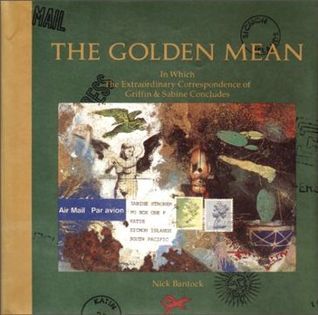
The Golden Mean by Nick Bantock is an exquisite culmination of his acclaimed Griffin & Sabine trilogy, bringing the correspondence between the enigmatic Sabine Strohem and the artist Griffin Moss to a haunting resolution. Bantock, master of visual storytelling, does more than complete a tale—he deepens the metaphysical layers of his narrative, blurring the boundaries between art, philosophy, and psychological exploration.
The book is a fusion of image and text, where the letters and illustrations intermingle to create a rich, immersive reading experience. As in the previous installments, the physicality of the letters is central to the story’s enchantment. Each page demands tactile engagement, drawing the reader into a private and surreal world where the characters’ intimacy transcends the ordinary bounds of epistolary novels. The inclusion of postcards, letters, and art objects as narrative tools elevates the form, making the story not merely something to read but something to behold and feel.
What sets The Golden Mean apart, however, is its philosophical undertones. The title itself, a reference to Aristotle’s concept of the desirable middle between extremes, reflects the thematic tension that runs through the novel. Griffin and Sabine are not only two individuals exchanging thoughts and emotions, but they also symbolize opposing forces—rationality versus intuition, grounded reality versus transcendent vision. Bantock’s depiction of their relationship echoes the idea that balance, or “the mean,” is essential for harmony, both in the internal self and in the outer world.
Yet, The Golden Mean is not content to rest on the laurels of an easy resolution. As Griffin grapples with the physical and metaphysical implications of Sabine’s existence, the reader, too, is left in a state of suspension. Is Sabine real? A manifestation of Griffin’s imagination? Or is there an entirely different plane of reality on which their connection flourishes? Bantock leaves these questions tantalizingly unresolved, making the book an open-ended meditation on perception, love, and the nature of existence.
From a literary perspective, Bantock’s work is as much about form as it is about content. His interweaving of narrative, illustration, and the very materiality of the book itself situates The Golden Mean in the tradition of visual storytelling that calls to mind the illuminated manuscripts of medieval times or the surrealist artworks of the 20th century. The artwork, with its dreamlike quality, complements the mysticism of the plot, further amplifying the otherworldly nature of Griffin and Sabine’s connection.
Bantock’s prose, spare but evocative, serves as a foil to the rich visual tapestry. He uses the economy of his words to great effect, allowing the visual elements to carry as much weight as the written. The result is a novel that refuses to be confined to a single genre—it is part epistolary fiction, part art book, part philosophical reflection.
In the end, The Golden Mean is a meditation on duality—of self, of art, of love. It pushes the boundaries of how stories are told, and how they are experienced. Bantock challenges readers to consider the limitations of perception, while also inviting them into a space where the line between the seen and unseen, the real and imagined, blurs with exquisite grace. For those willing to embrace the ambiguity, The Golden Mean offers not only a resolution to Griffin and Sabine’s story but also a deeper understanding of the paradoxes that govern the human condition.
Discover more from The New Renaissance Mindset
Subscribe to get the latest posts sent to your email.
 The New Renaissance Mindset
Wonderful post 🎸thanks for sharing🎸
LikeLiked by 1 person