
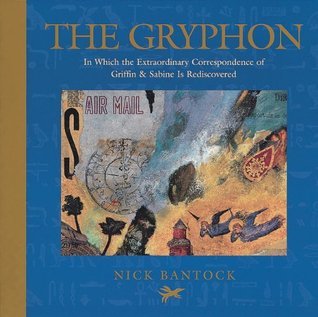
Nick Bantock’s The Gryphon is the fourth instalment in the Griffin & Sabine series, a collection of epistolary novels that have enchanted readers since its inception. The Gryphon continues the unconventional correspondence between Griffin Moss, the introspective artist, and Sabine Strohem, the enigmatic muse who communicates with him through letters that cross the boundaries of time, space, and reality itself.
At first glance, Bantock’s use of letters, postcards, and his signature lush illustrations may seem like a simple creative gimmick, but a closer examination reveals a rich narrative complexity. The book, much like its predecessors, straddles the line between art and literature, offering an experience that is both deeply visual and profoundly textual. This dynamic interplay is what elevates The Gryphon beyond the traditional form of the novel, as it delves into the themes of connection, identity, and the metaphysical boundaries of existence.
Where Bantock shines most is in his ability to draw readers into an intimate emotional world. The tactile nature of the letters, often meticulously crafted and beautifully illustrated, encourages a personal relationship with the narrative. Each page feels like an artifact, a fragment of a larger, mysterious puzzle, inviting readers not merely to witness the story but to participate in it. The act of turning each page feels almost like unsealing a private secret, enhancing the atmosphere of mystery and discovery.
Thematically, The Gryphon builds upon the Jungian elements present in the earlier books, diving deeper into questions of synchronicity, the collective unconscious, and the duality of inner and outer worlds. Bantock seems to ask: What defines reality? How does imagination shape our experience of others? These questions are embodied in the figures of Griffin and Sabine, whose relationship challenges the boundaries between dream and reality, mind and matter. Their letters, at once tangible and ethereal, offer meditations on the permeability of selfhood, hinting at a world where consciousness and connection transcend the physical.
This installment, however, takes a darker turn. Whereas the earlier books seemed to revel in the surreal romance between Griffin and Sabine, The Gryphon introduces a more ominous tone. The introduction of Frolatti, a sinister, almost mythic figure, shifts the balance of the narrative from one of discovery to one of potential threat. The sense of foreboding that shadows each letter suggests that Griffin’s and Sabine’s connection may not be purely benevolent, adding a layer of tension that enriches the storytelling.
Bantock’s artwork deserves special mention. The illustrations are not mere accompaniments but integral to the novel’s narrative texture. They reflect the emotional and psychological states of the characters, and the fusion of art and text creates a symbiotic relationship that mirrors the characters’ own struggle to navigate their interconnected yet fragmented realities. Each image feels like a doorway into the subconscious, as though the reader is given a visual manifestation of the thoughts and emotions hidden within the words of the letters.
If there is a critique to be made, it is that The Gryphon leaves many questions unanswered, particularly in the realm of plot. Readers seeking narrative closure may find themselves frustrated by the ambiguity that permeates the book. However, this very ambiguity is part of Bantock’s artistry. The open-endedness forces readers to confront the mystery head-on, to sit with the uncertainty rather than seek resolution, much like Griffin and Sabine themselves. In this sense, The Gryphon aligns more with the tradition of modernist or postmodern literature, where ambiguity and unresolved tension are used to reflect the complexities of existence.
Ultimately, The Gryphon is a work of profound imagination and emotional depth, blending art and literature in a way that challenges traditional narrative structures. Bantock crafts an experience that is as much about the form as it is about the content, inviting readers to question the nature of storytelling itself. With its intricate design, evocative art, and philosophical undercurrents, The Gryphon stands as a testament to Bantock’s unique vision—one that lingers in the mind long after the final letter is read.
In the end, The Gryphon is less a novel to be understood than it is an experience to be felt, a journey through the intertwined realms of thought, art, and emotion. It is a rare literary work that invites as much reflection on its form as on its meaning, leaving the reader suspended in its delicate web of mystery and beauty.
Discover more from The New Renaissance Mindset
Subscribe to get the latest posts sent to your email.
 The New Renaissance Mindset