
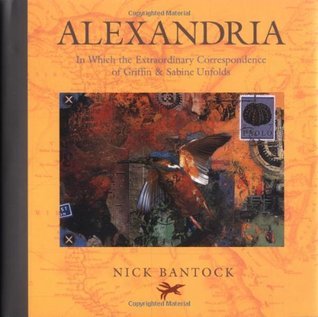
In Alexandria, Nick Bantock once again proves himself a master of the epistolary form, seamlessly blending visual artistry and literary craftsmanship. This novel, the fifth in the Griffin & Sabine series, continues the enigmatic and often surreal correspondence between Griffin Moss, a London-based artist, and Sabine Strohem, a mysterious illustrator from the South Pacific. In this iteration, their letters are joined by those of a third party, Matthew Sedon, an archaeologist, and Isabella de Reims, a French scholar—introducing new layers to the already complex web of intrigue and mysticism.
At first glance, Alexandria appears to be a continuation of the previous books’ correspondence and visual style, but Bantock deepens his thematic exploration in this entry. While previous volumes focused on the duality of distance and connection, reality and fantasy, Alexandria delves into the nature of knowledge itself, posing existential questions about the boundaries between personal history and collective memory. The novel’s namesake—the ancient city of Alexandria—functions as a metaphorical site of lost wisdom, bridging the present with the long-forgotten. It evokes an atmosphere of intellectual yearning, of seeking what may be forever out of reach.
Bantock’s blending of letters and artwork creates a deeply immersive experience. Each envelope, postcard, and artifact serves not only as a plot device but also as a reflection of the characters’ inner lives. The illustrations are not simply complementary but integral, demanding a visual literacy from the reader that is rare in contemporary literature. This dynamic is reminiscent of early modernist works, where form and content are indivisible, and it calls to mind the artistic ambitions of the Surrealists, who sought to disrupt the linearity of narrative and consciousness itself.
One of the most striking aspects of Alexandria is its manipulation of time. The letters between the characters exist in different temporal spaces, which lends an unsettling quality to the narrative. Griffin and Sabine’s mystical bond seems to transcend the ordinary flow of time, a concept that Bantock plays with masterfully, suggesting that time itself is subjective, tied more to the emotional and psychological states of the characters than to any objective chronology.
In this sense, Alexandria can be seen as a meditation on temporality and the role of art in capturing the ephemeral. The novel implicitly argues that art, whether visual or textual, is a form of resistance against the erasure of time. By chronicling the correspondence of his characters, Bantock is not just telling a story—he is preserving a moment in history, both personal and universal.
The dialogue between the past and present, between ancient Alexandria and the contemporary world, hints at a deeper exploration of the act of remembering. Bantock’s prose, elegant and sparse, mimics the structure of his plot. He resists giving readers easy answers, instead inviting them to grapple with the story’s ambiguities. The letters, like the city of Alexandria itself, hold secrets that may never be fully deciphered.
While Alexandria is a visually stunning and intellectually stimulating read, its pacing may frustrate readers accustomed to more traditional narrative structures. The epistolary form, while engrossing, can feel disjointed at times, particularly as the novel juggles multiple voices and points of view. However, this very quality is what makes Bantock’s work so unique—it is a novel that demands patience, contemplation, and an openness to the fluid boundaries between form and meaning.
In conclusion, Alexandria is more than a continuation of Griffin and Sabine’s story; it is a philosophical exploration of the power of art, memory, and love. Bantock’s ability to weave together visual and literary elements creates a deeply immersive narrative that resonates on both intellectual and emotional levels. For those willing to engage with its complex structure and themes, Alexandria offers a rich and rewarding experience, a reminder that the boundaries of time and space can be transcended through the simple act of communication.
Discover more from The New Renaissance Mindset
Subscribe to get the latest posts sent to your email.
 The New Renaissance Mindset