
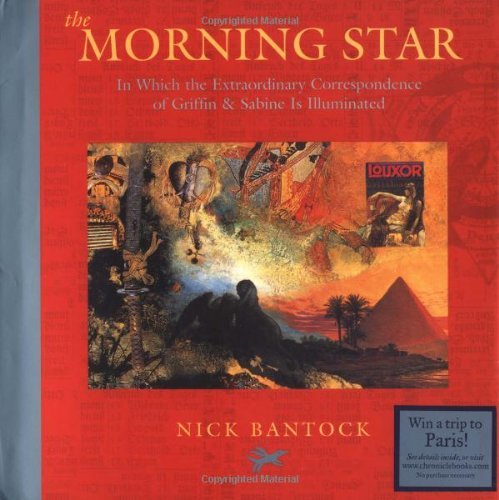
The Morningstar by Nick Bantock is a captivating exploration of epistolary narrative, art, and the mysteries of the human psyche, enveloped in the dreamlike atmosphere that Bantock has mastered over his previous works. As the final installment of The Griffin and Sabine series, The Morningstar delicately intertwines visual art with written correspondence, creating a multifaceted experience that is as much about the art of storytelling as it is about the story itself.
Bantock, as always, plays with the boundaries between text and image, immersing the reader in the tactile experience of letters, postcards, and artwork that seem to breathe with life. The correspondence between Sabine, Griffin, and the enigmatic figure of Morningstar unfolds with a mysticism that blurs the line between reality and the subconscious. The letters are not mere exchanges of words; they are deeply symbolic artifacts, heavy with subtext, and rich in visual language. The inclusion of physical letters and postcards as integral narrative devices evokes a sense of intimacy and mystery, engaging the reader as a participant in the unfolding drama.
Thematically, The Morningstar is a meditation on the act of creation, particularly the elusive nature of inspiration and artistic connection. Bantock uses his characters as embodiments of creative tension—Griffin, the grounded artist struggling with his vision; Sabine, the muse who is both ethereal and tangible; and Morningstar, a catalytic force who represents the untapped or suppressed dimensions of creative potential. These figures are not only characters but symbols of the different facets of the artist’s psyche. In this sense, the novel functions as a metaphysical dialogue on the relationship between artist, muse, and creation.
Bantock’s use of the epistolary form allows for an interplay between public and private selves, as Griffin and Sabine’s correspondence reveals their inner worlds in fragmented, poetic pieces. What is left unsaid in their letters is just as important as what is written, and the gaps between communication serve as fertile ground for interpretation, offering the reader the chance to project their own emotional and intellectual readings onto the story. Bantock encourages an active reading, demanding that the audience engage not only with the narrative but with the aesthetics of the art on each page.
The symbolic weight of The Morningstar also extends into metaphysical territory, touching on Jungian themes of duality, the anima and animus, and the confrontation with the shadow self. The correspondence between Griffin and Sabine is, in many ways, an exploration of the unconscious and the tension between inner and outer realities. Bantock layers these themes with a mysticism that draws heavily from archetypal symbolism, offering a narrative that feels both deeply personal and universally resonant.
However, one of the novel’s few challenges may lie in its somewhat elliptical structure. For readers unfamiliar with the previous books in the series, The Morningstar may feel incomplete or overly cryptic. The novel assumes a certain level of familiarity with the dynamics between Griffin and Sabine, and without that foundation, some of the emotional and thematic richness may be lost. Yet, for those who have journeyed with Bantock through the series, The Morningstarprovides a satisfying and thought-provoking conclusion that leaves as many questions as it answers.
In terms of literary tradition, Bantock’s work situates itself within a niche that combines visual art, literature, and the physicality of the book as an object. His integration of these elements can be seen as part of a broader conversation about the evolution of narrative form, particularly as it relates to the postmodern blending of high and low art. Bantock’s approach is a celebration of the book as a multidimensional art form, one that defies the purely textual and invites the reader to engage with narrative through multiple sensory channels.
In conclusion, The Morningstar is a richly textured and aesthetically mesmerizing work that challenges traditional narrative forms while exploring profound themes of art, creation, and the mysteries of the human soul. Bantock’s ability to weave together visual and verbal storytelling offers a singular reading experience, one that lingers in the mind long after the final letter is read. For those willing to surrender to its dreamlike logic and embrace its mysteries, The Morningstar is a rewarding and evocative journey.
Discover more from The New Renaissance Mindset
Subscribe to get the latest posts sent to your email.
 The New Renaissance Mindset