
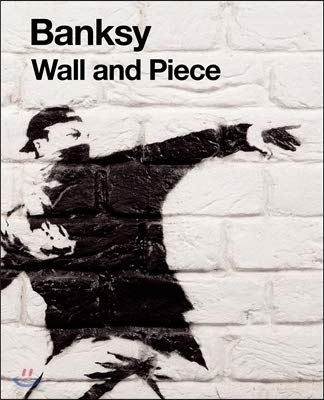
Banksy’s Wall and Peace is not just a compilation of graffiti art; it’s an artistic manifesto that defies traditional notions of public space, art ownership, and socio-political commentary. Through the juxtaposition of raw imagery and biting text, Banksy offers readers a visual rebellion against societal norms, inviting them to reflect on global issues like consumerism, militarism, environmental degradation, and the commodification of culture.
At first glance, Wall and Peace can be mistaken for an art book—a coffee-table collection of graffiti pieces spread across cities and countries. However, upon closer inspection, it becomes apparent that the book is a sophisticated critique of power structures, delivered in Banksy’s signature sardonic tone. What makes Wall and Peace stand out is how it transcends the medium of graffiti, traditionally seen as a subversive, temporary form of street art. In this book, Banksy creates a lasting legacy for a form of art that is often washed away, censored, or dismissed as vandalism.
The layout of the book is deliberately erratic, with images placed next to brief captions that are laced with irony and wit. This approach mimics the experience of encountering Banksy’s work in the wild—stumbling upon a wall, a stencil, a message. Each piece is designed to provoke, unsettle, or amuse, depending on the viewer’s perspective. The work itself embodies a modern-day punk ethos, challenging the reader to question the role of art in the urban environment and the institutions that regulate it.
One of the strongest elements of Wall and Peace is Banksy’s ability to make the local universal. His art comments on the specific issues plaguing cities—police brutality, the prison-industrial complex, surveillance, and corporate overreach—yet the resonance is global. A piece from London’s Shoreditch feels just as relevant on a wall in Gaza or in the streets of New York City. This is perhaps the book’s most profound contribution to contemporary discourse: the realization that these seemingly distinct issues are interconnected, that the walls separating us from peace are man-made and universal.
As a literary object, Wall and Peace borrows from traditions of political satire, street protest, and art theory. Banksy’s captions are reminiscent of the sharp, concise humor of Jonathan Swift, while his imagery evokes the boldness of political posters from revolutionary movements. There is also an undeniable influence of Dadaism in his work, as it embraces absurdity to critique the absurdities of modern life. The dissonance between the playful visual style and the serious messages allows the art to slip past viewers’ defenses, prompting reflection after the initial shock or amusement wears off.
The book also highlights Banksy’s elusive persona, which adds an additional layer of intrigue. Who is Banksy? How does anonymity serve the cause of the art? These questions remain unanswered, but they serve to underline one of the book’s central themes: the artist is secondary to the message. By remaining faceless, Banksy allows the focus to remain on the social issues depicted in his art. In a time when celebrity and fame often overshadow content, Wall and Peace offers a refreshing inversion, where the art stands as the sole point of reference.
In conclusion, Wall and Peace is an essential read for anyone interested in modern art, political commentary, or the ways in which public spaces can become platforms for dissent. It captures the power of graffiti as a democratic medium that speaks truth to power in a way few other art forms can. More than a mere catalogue of Banksy’s work, the book is a reflection on the possibility of art as a tool for change—provocative, humorous, and ultimately, hopeful in its own rebellious way.
Discover more from The New Renaissance Mindset
Subscribe to get the latest posts sent to your email.
 The New Renaissance Mindset