
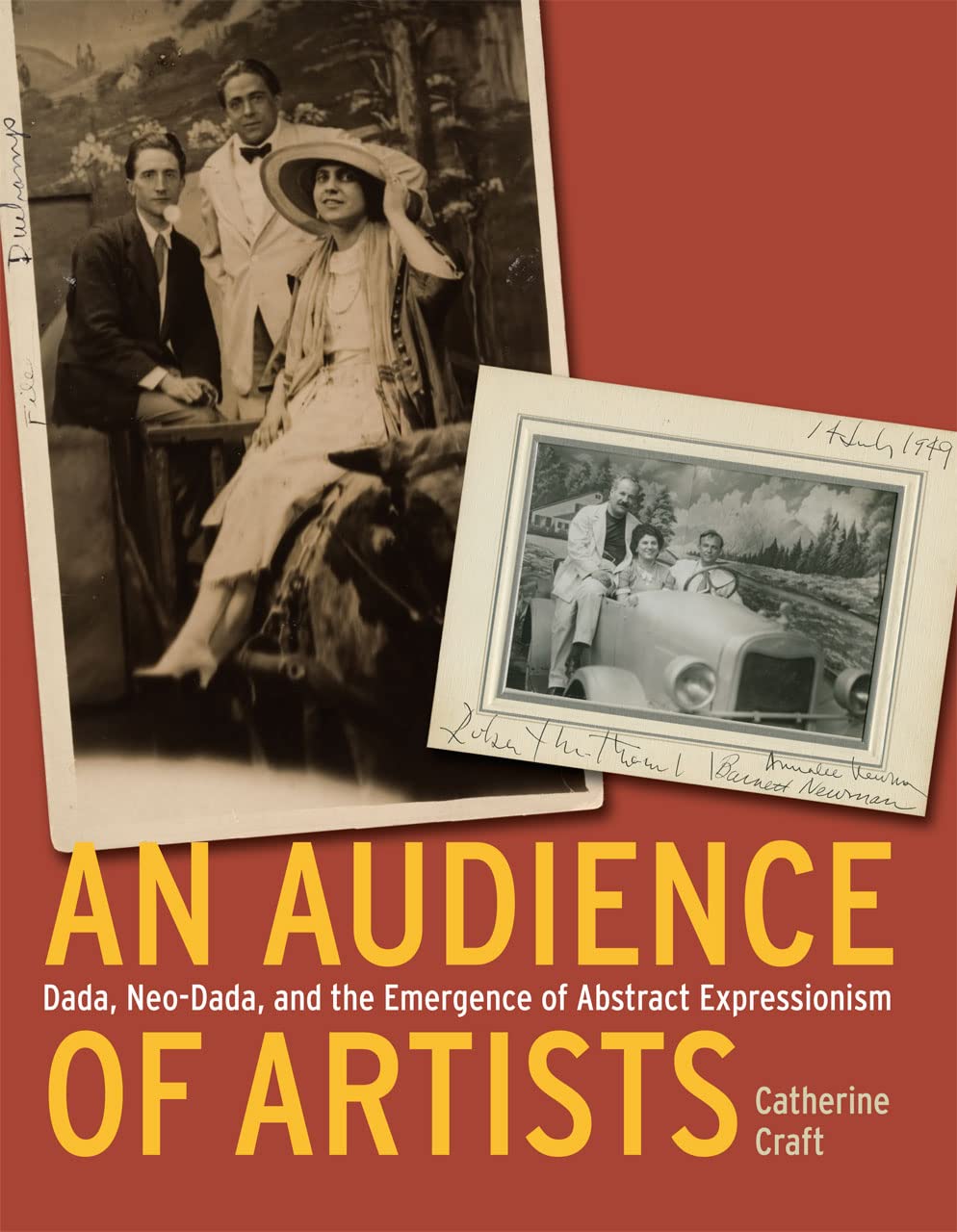
Catherine Craft’s An Audience of Artists: Dada, Neo-Dada, and the Emergence of Abstract Expressionism is a meticulously researched and intellectually rich exploration of the undercurrents that shaped one of the most transformative periods in modern art. With a scholar’s rigor and a storyteller’s sensitivity, Craft charts the intricate web of influences that wove together the radical avant-garde practices of Dada and Neo-Dada with the gestural dynamism of Abstract Expressionism, illuminating their shared tensions and divergences.
Craft’s central thesis—that the innovations of Dada and Neo-Dada played a pivotal yet often underappreciated role in the development of Abstract Expressionism—is compellingly argued. She navigates a landscape where disparate movements are connected by shared philosophical inquiries: the subversion of traditional hierarchies, the rejection of mimesis, and the quest for authenticity in a fractured world. Yet, Craft’s approach avoids the pitfalls of oversimplification. Instead, she delves deeply into the nuances of these movements, offering a layered analysis that captures the complexity of their interplay.
One of the book’s most remarkable achievements is its recontextualization of Abstract Expressionism, a movement often lionized for its heroic individualism. By examining the dialogues between figures such as Marcel Duchamp, Robert Rauschenberg, and Jackson Pollock, Craft uncovers how the conceptual provocations of Dada and Neo-Dada reverberated within the Abstract Expressionist ethos. For example, her analysis of Duchamp’s readymades as precursors to Pollock’s drip paintings challenges the traditional narrative of Abstract Expressionism as purely an American, self-generated phenomenon. Instead, Craft demonstrates how it was, in part, a response to and evolution of the global avant-garde.
Equally impressive is Craft’s attention to the materiality and performative aspects of art-making. Her detailed examinations of works like Rauschenberg’s Erased de Kooning Drawing and Pollock’s action paintings foreground the embodied processes of creation, emphasizing the tension between control and chance, presence and absence. This focus not only bridges the conceptual gap between Dada’s irreverent playfulness and Abstract Expressionism’s existential gravitas but also situates the artists as participants in a shared lineage of risk and experimentation.
Craft’s writing is elegant yet accessible, offering clear explanations of complex ideas without sacrificing intellectual depth. Her scholarship is fortified by an impressive range of primary sources, from artists’ writings to archival materials, which she weaves seamlessly into her narrative. Particularly noteworthy is her ability to bring the historical and cultural contexts of these movements to life, situating them within the broader currents of 20th-century thought, including existentialism, postwar disillusionment, and the shifting dynamics of the art market.
While the book’s scope is ambitious, Craft maintains a tight focus, resisting the temptation to stray into tangential areas. This discipline ensures that her arguments remain coherent and impactful. However, one could argue that the book’s concentration on a relatively small group of canonical artists may leave some readers wishing for a broader inclusion of marginalized voices—particularly those of women and non-Western artists—who also engaged with the ideas and practices discussed.
Ultimately, An Audience of Artists is a significant contribution to art historical scholarship. By reframing the narrative of Abstract Expressionism and highlighting its indebtedness to Dada and Neo-Dada, Craft challenges readers to reconsider the porous boundaries between movements and the collaborative spirit of artistic innovation. This book is essential reading not only for scholars of modern art but for anyone seeking to understand the dialogues and disruptions that have defined the art of the 20th century. It is a testament to the enduring power of art to reflect, challenge, and transform the conditions of its time.
Discover more from The New Renaissance Mindset
Subscribe to get the latest posts sent to your email.
 The New Renaissance Mindset