
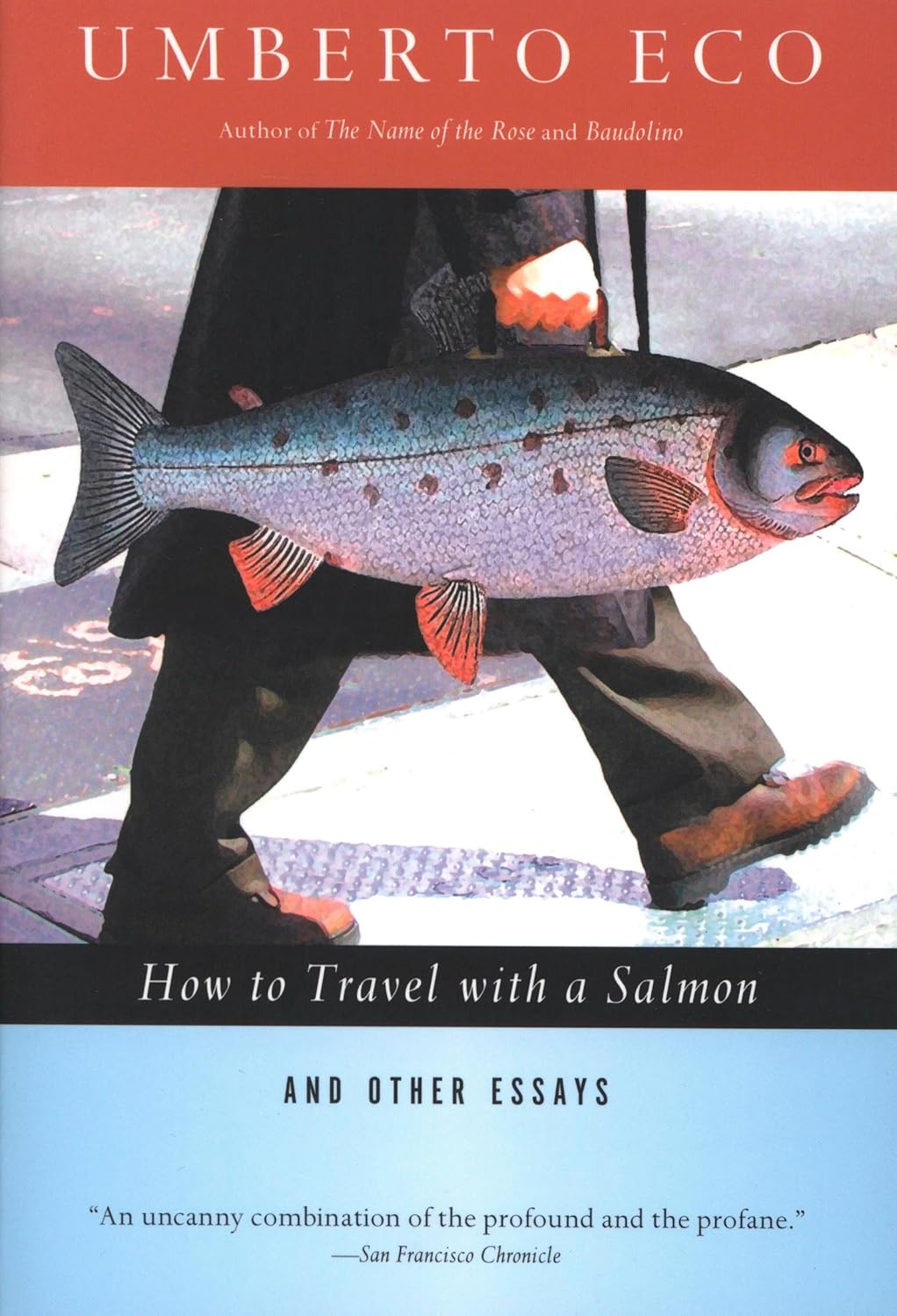
Umberto Eco’s How to Travel with a Salmon: And Other Essays is a dazzling showcase of wit, erudition, and an almost surgical observation of the absurdities of modern life. This collection, translated by William Weaver, epitomizes Eco’s ability to oscillate effortlessly between the profound and the comically mundane, proving that even the minutiae of existence can be fertile ground for intellectual exploration.
At first glance, the essays might seem whimsical, even frivolous. The titular piece, “How to Travel with a Salmon,” narrates a hilariously Kafkaesque experience involving airline bureaucracy and a smoked salmon. But beneath the humor lies Eco’s characteristic critique of systems—whether technological, bureaucratic, or cultural—that render human beings powerless, a recurring theme in his broader oeuvre.
Eco’s essays delve into a variety of topics: from the surreal rituals of academic conferences to the peculiarities of computer interfaces, the mechanics of bookshops, and the ridiculous yet pervasive nature of political correctness. What unites these seemingly disparate essays is Eco’s keen sense of irony and his mastery of semiotics, the study of signs and symbols, which underpins much of his work. For instance, his critique of computer manuals in “How to Use the Coffee Machine” transcends mere frustration with technology; it becomes a meditation on the disjunction between human needs and the alienating language of machines.
The brilliance of Eco’s prose lies in its deceptive simplicity. While these essays are accessible, their underlying intellectual scaffolding is immense. A literary scholar will detect shades of Montaigne’s reflective essays, the biting satire of Jonathan Swift, and the absurdism of Albert Camus. Eco’s essays, however, are distinctly his own, imbued with his vast interdisciplinary knowledge and a distinctly Italian sensibility—a kind of philosophical playfulness that resists categorization.
Perhaps most compelling is Eco’s exploration of the human condition in a world increasingly dominated by technology and consumerism. His observations often verge on the prophetic, foreseeing the challenges of a hyper-connected, media-saturated society. In “How to Replace a Driver’s License,” Eco’s ordeal with Italian bureaucracy transcends its local context, becoming a universal commentary on the alienation of the individual in an age of faceless institutions.
The humor in Eco’s essays is a crucial device, making his critiques palatable and engaging. Yet, the laughter he provokes is not without a sting. Beneath the comedy lies a profound sense of melancholy for a world that is losing its grip on simplicity and sincerity. His essays are not only amusing; they are thought-provoking, demanding readers to question their habits, assumptions, and the systems they inhabit.
How to Travel with a Salmon is an essential read for anyone who appreciates the intersection of intellect and humor. For literary scholars, it offers a rich tapestry of intertextual references and philosophical insights. For the casual reader, it is a delightful and accessible introduction to Eco’s genius. Above all, the collection is a testament to Eco’s belief in the enduring power of curiosity and critical thought, even—or especially—when navigating the absurdities of modern life.
Verdict:
Eco’s essays, much like his fiction, are a labyrinth—full of surprises, digressions, and moments of epiphany. Whether you approach them as light-hearted reflections or as deeply layered commentaries on the state of humanity, you will find yourself laughing, pondering, and perhaps even questioning how you, too, might travel with a metaphorical salmon.
Discover more from The New Renaissance Mindset
Subscribe to get the latest posts sent to your email.
 The New Renaissance Mindset