
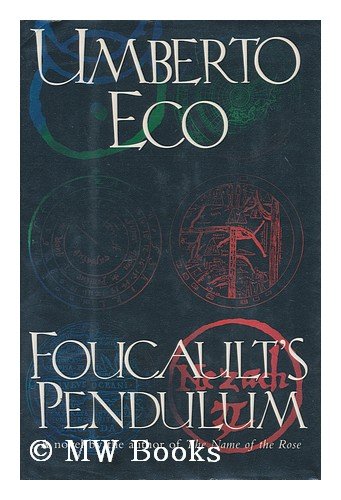
In Foucault’s Pendulum, Umberto Eco constructs an intricate tapestry of erudition, mystery, and satire, challenging the reader to question not only the nature of truth but the human propensity to impose meaning on the chaotic flux of existence. A meta-textual labyrinth of ideas, the novel synthesizes Eco’s hallmark themes of semiotics, historiography, and the seduction of conspiracy narratives into a literary journey as intellectually demanding as it is rewarding.
At its heart, the novel tells the story of three intellectuals—Casaubon, Belbo, and Diotallevi—working at a Milanese publishing house. Disillusioned by the sensationalism of occult literature submitted for publication, they create “The Plan,” an elaborate, fictional conspiracy linking the Knights Templar, Rosicrucians, Freemasons, and other secret societies in a fabricated plot to control the world. Yet, as their fabrication takes on a life of its own, reality and fiction blur, culminating in a harrowing exploration of belief and its consequences.
Eco’s narrative is a homage to literary and philosophical tradition, demanding that readers grapple with a dense array of intertexts, from Dante and Kabbalistic mysticism to René Descartes and James Joyce. He employs an encyclopedic prose style, reflecting the polymathic depth of the protagonists while weaving a metafictional critique of the same intellectual hubris they exhibit. This creates a layered reading experience where the act of interpretation itself becomes a central theme.
The Pendulum as a Symbol
The titular Foucault’s Pendulum, a scientific marvel demonstrating Earth’s rotation, operates as a profound metaphor in the novel. It symbolizes the immutable laws of nature contrasted against humanity’s ceaseless invention of ideological frameworks to give order to the universe. Through this duality, Eco probes the tension between science and mysticism, reason and superstition, grounding the novel in the epistemological questions central to postmodern thought.
The Allure and Danger of Meaning
Eco masterfully deconstructs the human compulsion to uncover hidden patterns in randomness. The Plan, initially conceived as a satirical exercise, seduces its creators, illustrating how even the most skeptical minds are not immune to the allure of coherence. The story’s descent into paranoia and existential dread mirrors the historical allure of conspiracy theories, inviting readers to reflect on the fine line between intellectual curiosity and fanaticism.
Characterization and Human Vulnerability
Casaubon, the narrator, is a stand-in for the reader, an erudite but increasingly unreliable guide through Eco’s labyrinthine narrative. Belbo, whose musings on the nature of storytelling and unfulfilled desire are poignantly captured in his computer’s enigmatic entries, emerges as the novel’s tragic core. Through these characters, Eco presents a profound meditation on the limitations of knowledge and the human yearning for transcendence.
A Novel of Our Times
Though written in 1988, Foucault’s Pendulum resonates strikingly in our age of internet-fueled misinformation and conspiracy theories. Eco anticipates the ways in which the democratization of knowledge can devolve into epistemological chaos, where the boundaries between credible scholarship and pseudoscience collapse. The novel is a cautionary tale, urging vigilance against the seductive simplicity of totalizing explanations.
The Challenges of the Text
Admittedly, Foucault’s Pendulum is not a work for the faint of heart. Eco’s penchant for arcane references and academic density may alienate readers unfamiliar with the historical and philosophical frameworks he employs. Yet, for those willing to immerse themselves in its intellectual rigor, the novel offers a deeply rewarding exploration of the interplay between knowledge, power, and belief.
Foucault’s Pendulum is a masterwork of postmodern literature, a text that challenges and transcends the boundaries of the novel. Through its dazzling interweaving of erudition and narrative, Eco crafts a profound meditation on the dangers of intellectual hubris, the construction of meaning, and the human condition’s vulnerability to its own creations. It is a book to be savored, interrogated, and revisited—a pendulum that swings perpetually between enlightenment and obscurity, reason and madness.
In the end, Umberto Eco’s novel stands as both a warning and a celebration: a testament to the power of ideas and the perils of taking them too far.
Discover more from The New Renaissance Mindset
Subscribe to get the latest posts sent to your email.
 The New Renaissance Mindset