
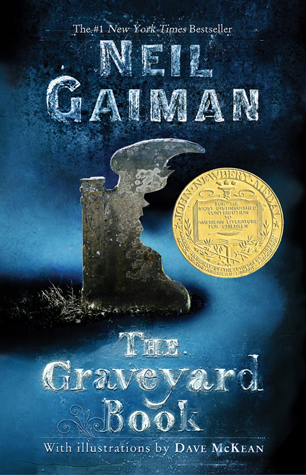
Neil Gaiman’s The Graveyard Book (2008) is a modern gothic masterpiece that seamlessly blends the macabre with the whimsical, evoking literary echoes of Rudyard Kipling’s The Jungle Book, Charles Dickens’ Great Expectations, and the ghostly eeriness of Edgar Allan Poe. In this darkly enchanting novel, Gaiman weaves an intricate narrative of loss, survival, and the complexities of identity, all while maintaining a tone that is both haunting and profoundly tender.
A Story Between Life and Death
At its core, The Graveyard Book follows the life of Nobody Owens (Bod), a boy raised by ghosts in an old graveyard after the brutal murder of his family. The novel opens with a chilling scene: the assassin Jack prowls through the Owens household, his knife gleaming with sinister intent. The toddler, escaping by sheer accident, toddles into the graveyard, where he is granted the “Freedom of the Graveyard” and taken in by spectral caretakers.
Gaiman constructs the novel episodically, reminiscent of The Jungle Book, with each chapter presenting a self-contained adventure in Bod’s growth. However, unlike Kipling’s Mowgli, who moves between the jungle and human civilization, Bod’s world is inverted—his haven is among the dead, while the living pose the true danger. This reversal establishes a rich thematic tension that underlies the entire novel: the graveyard, traditionally a place of decay and stagnation, becomes a site of growth, learning, and unexpected vitality for Bod.
Narrative and Style: The Power of Myth and Storytelling
Gaiman’s prose, typically restrained yet evocative, employs a timeless, fable-like quality. The omniscient narration allows for a fluid movement between the eerie and the whimsical, conjuring a tone that is at once comforting and unsettling. His storytelling mirrors the oral traditions of folklore, where the supernatural and the mundane intertwine seamlessly.
The novel’s structure and pacing recall the storytelling techniques of classic British literature. Dickensian influences appear in Bod’s encounters with characters like Liza Hempstock, a tragic witch buried in a potter’s field, whose arc evokes both Bleak House’s Jo and Pip’s moral awakenings in Great Expectations. The Man Jack and his shadowy organization echo the sinister, inexplicable forces of classic gothic fiction, drawing comparisons to Nathaniel Hawthorne and Shirley Jackson in their quiet, creeping horror.
Themes: Identity, Belonging, and the Nature of Fear
One of the novel’s most poignant themes is the question of identity. Bod straddles the world of the living and the dead, never fully belonging to either. This liminality reflects the universal coming-of-age struggle—the search for selfhood in a world that constantly defines one through labels and limitations. His name, Nobody, is a clever linguistic play that reflects his ambiguous place in the world. Like many of Gaiman’s protagonists (Coraline, The Ocean at the End of the Lane), Bod exists in a liminal space between reality and myth, struggling to claim his own identity.
Another theme deeply interwoven in the novel is the concept of fear. The living fear the dead, yet in Bod’s world, the true menace comes from the living—especially from the enigmatic Jacks of All Trades, an ancient secret society that sees Bod as a threat to their existence. Gaiman subtly critiques the way fear distorts perception, suggesting that what we fear is often misunderstood and that true evil lies not in ghosts, but in those who wield power in the shadows.
A Haunting Yet Hopeful Conclusion
The novel’s conclusion is both melancholy and liberating. As Bod grows, the spectral protections of the graveyard fade, forcing him into the world of the living. It is a necessary but bittersweet transition, reinforcing Gaiman’s central assertion: childhood is a place of magic, but one must inevitably leave it behind. The final pages, where Bod walks away into the unknown, resonate deeply as a meditation on growing up and stepping into a world filled with both wonder and uncertainty.
The Graveyard Book is a triumph of contemporary fantasy, an elegant fusion of gothic horror, folklore, and coming-of-age narrative. Gaiman pays homage to literary traditions while crafting something wholly original—a story that feels both timeless and urgent. Like all great works of children’s literature, it refuses to condescend to its audience, instead offering a rich tapestry of ideas about life, death, and the spaces in between.
This is not just a book about ghosts; it is a book about the beauty of fleeting moments, the necessity of change, and the ways in which we carry the dead with us—not as burdens, but as lessons, as stories, as love that lingers in the air long after the final page is turned.
Discover more from The New Renaissance Mindset
Subscribe to get the latest posts sent to your email.
 The New Renaissance Mindset
Really enjoyed this review. Huge fan of Gothics.
LikeLiked by 1 person
Thank you, Chris.
I really appreciate the comment!
M.
LikeLiked by 1 person
Nice review.
LikeLike