
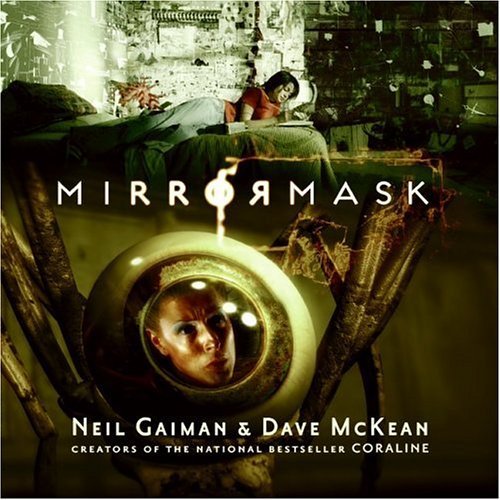
Neil Gaiman’s Mirrormask (2005), a novelization of the film co-created with artist Dave McKean, is a hypnotic dreamscape of a narrative that oscillates between childhood and adolescence, reality and fantasy, identity and self-discovery. Infused with Gaiman’s signature mythopoetic storytelling and McKean’s surreal visual sensibilities, Mirrormask presents itself as a modern fairy tale, steeped in the gothic and absurdist traditions of Lewis Carroll and Franz Kafka.
Narrative as Metaphor: The Labyrinthine Self
The novel follows Helena, a young girl raised in a traveling circus, who longs for an ordinary life—until she is catapulted into a distorted, nightmarish version of her reality. Her journey through the Dark Lands, where the balance between two opposing queens has been shattered, is at once an adventure and an introspective odyssey. Like Carroll’s Alice, Helena traverses a wonderland that functions as an externalized subconscious, populated by eerie, hybridized creatures and shifting dream logic. Yet, unlike Alice, Helena is not merely a visitor to this realm; she is implicated in its imbalance, a theme that echoes the psychoanalytic notion of the fragmented self.
Gaiman’s world-building is deeply intertextual, drawing on archetypal hero’s journey structures but subverting them through a postmodern lens. Helena does not merely defeat an external antagonist—she confronts a mirror version of herself, the eponymous Mirrormask, in a confrontation that is less about vanquishing evil than about reclaiming and integrating fractured identity. The doppelgänger motif, a recurring element in gothic literature, becomes here a vehicle for adolescent self-definition, recalling Dostoevsky’s The Double or Stevenson’s Strange Case of Dr. Jekyll and Mr. Hyde.
Gaiman’s Poetics: Liminality and the Grotesque
Linguistically, Mirrormask is an exercise in liminality. Gaiman employs a fairy-tale cadence, deceptively simple but layered with implicit philosophical inquiry. The novel’s dialogue and narration oscillate between whimsical absurdity—reminiscent of Beckett’s existential playfulness—and lyrical melancholy. In moments of darkness, the prose sharpens into something akin to Poe’s gothic sensibilities, hinting at the hidden horrors within the psyche.
The grotesque plays a crucial role in Mirrormask, not in the Grand Guignol sense, but in the Bakhtinian sense of the carnival: bodies and identities are fluid, monstrous, and transformative. The shifting landscapes of the Dark Lands echo the organic and unpredictable grotesquerie of McKean’s illustrations, reinforcing the novel’s interrogation of mutable identity. This aesthetic of distortion, both verbal and visual, resists easy categorization and instead cultivates an atmosphere of the uncanny.
Thematic Resonance: Art, Adolescence, and the Search for Meaning
Beneath its surrealist surface, Mirrormask is an allegory of artistic identity. Helena, caught between two worlds, mirrors the duality of the artist—one foot in reality, the other in creation. The novel poses implicit questions about the nature of imagination: Is it an escape, or is it an inextricable component of selfhood? In Gaiman’s tradition, it is both. The act of drawing—Helena’s primary mode of expression—becomes an act of world-making, aligning the novel with metafictional traditions where art itself is a means of transformation.
The novel also explores the fraught transition from childhood to adulthood, a theme Gaiman revisits throughout his oeuvre (Coraline, The Ocean at the End of the Lane). Helena’s journey is not merely one of adventure but of reluctant growth, underscoring the existential cost of leaving childhood behind. Unlike the traditional coming-of-age narrative, Mirrormask suggests that adulthood is not a destination but an ongoing negotiation of selves—an ever-present mirror we must navigate.
A Fractured Fairytale for a Postmodern Audience
Mirrormask is more than a novel; it is a palimpsest of dream and reality, narrative and image, myth and self. Gaiman, in collaboration with McKean’s visual world-building, crafts a tale that is as unsettling as it is enchanting, as cerebral as it is visceral. While it borrows from fairy tale conventions, it ultimately transcends them, offering instead a meditation on identity, creativity, and the liminality of selfhood.
As with much of Gaiman’s work, Mirrormask resists singular interpretation. It invites the reader to become a participant, to find their own reflection in its shifting surfaces. Whether read as a surreal adventure, a psychological parable, or an artist’s manifesto, the novel lingers in the mind like an unfinished dream—one that, much like Helena’s journey, demands to be revisited, reimagined, and ultimately, redefined.
Discover more from The New Renaissance Mindset
Subscribe to get the latest posts sent to your email.
 The New Renaissance Mindset
Nice review.
LikeLiked by 1 person