
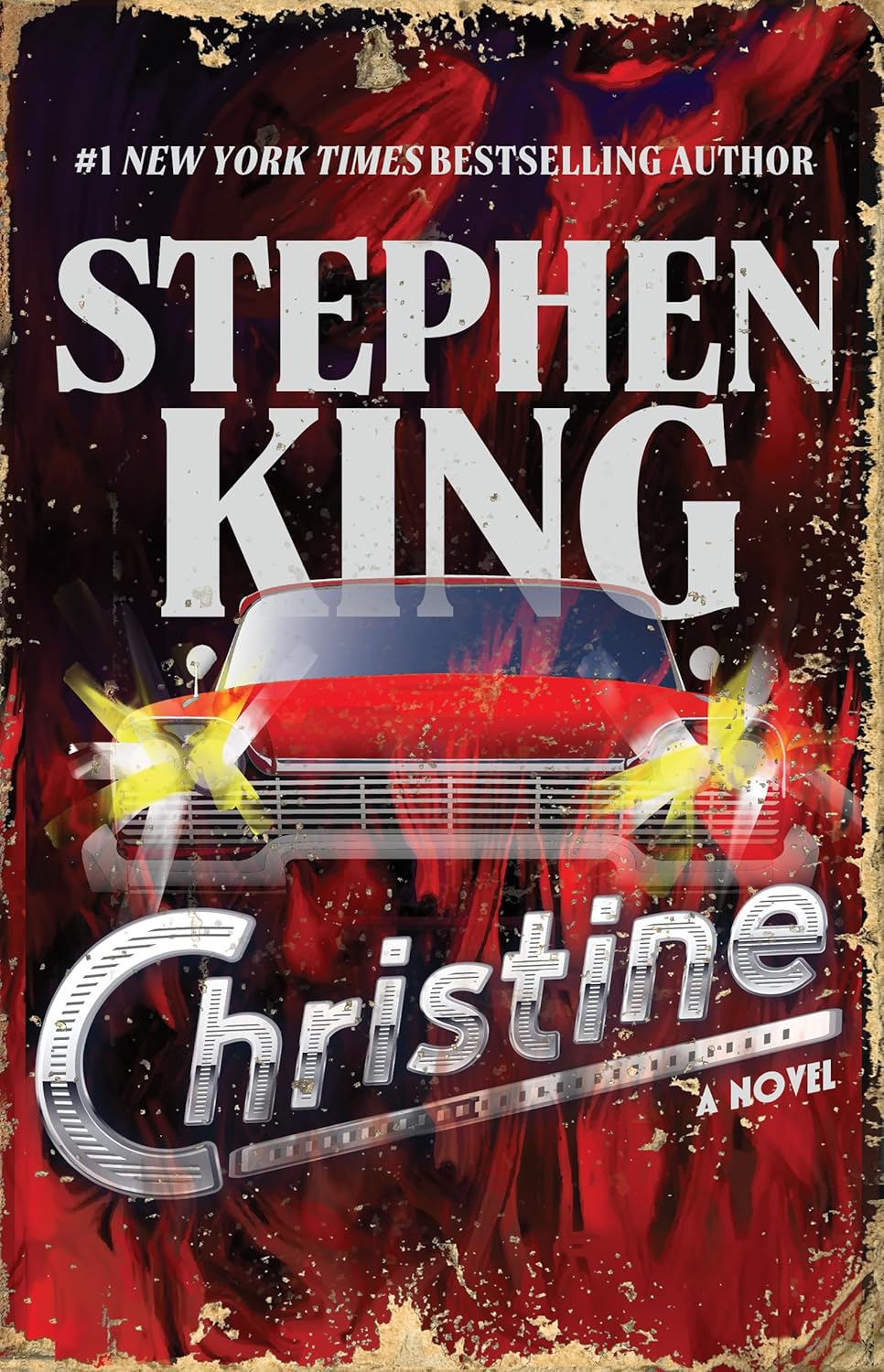
Stephen King’s Christine (1983) occupies a fascinating nexus between technological fetishism and supernatural horror, reanimating the automobile—an icon of mid-century American modernity—into a predator stalking the streets of small-town New England. More than a straightforward ghost story, Christine interrogates the boundaries between human agency and the seductive autonomy of machines, framing the novel as both a period piece and an enduring parable of obsession.
Possession and the Machine as Other
At its core, Christine is a tale of possession: not merely the demonic inhabitation of the 1958 Plymouth Fury, but the gradual usurpation of human will by the car’s malevolent spirit. Arnie Cunningham’s transformation—from a gawky, bullied teenager into a surly, self-assured (even cruel) devotee of Christine—mirrors the classic Faustian bargain. Here, Christine acts as a surrogate for the destructive promises of technology: she grants Arnie power, swagger, and social status at the expense of his moral center and his humanity.
King’s prose stages this metamorphosis with uncanny precision. Early descriptions of Christine’s corroded exterior and peeling paint evoke a corpse awaiting resurrection, while the car’s gradual restoration parallels Arnie’s physical and psychological rebirth. Yet the novel never soft-pedals the cost: his relationship with girlfriend Leigh Cabot fractures under Christine’s jealous influence, and his friendships with Dennis and Buddy strain as Christine demands ever more sacrifices.
Nostalgia, Americana, and the Gothic
Christine is situated squarely within the “Mid-Century American Gothic.” The quaint small-town setting—complete with drive-in diners, penny-authorized movie theaters, and cruising culture—imbues the narrative with a sense of nostalgia even as King subverts it. The 1950s Fury represents the apex of postwar consumer confidence: chrome-laden, flame-red, an emblem of freedom. Yet by investing Christine with a sentience that preys upon youthful vulnerability, King reveals how the same objects that once symbolized promise can harbor latent violence.
Moreover, Christine’s resurrection of 1958 into 1978 (the novel’s present) suggests the persistence—and danger—of unexamined cultural myths. Just as Christine’s engine roars to life with a vengeance, King implies that American myths of progress and power can animate forces that resist human control.
The Dynamics of Fear and Sympathy
One of the novel’s remarkable achievements is the ambivalent reader response it engenders. Christine occasionally evokes genuine pity—her rusted frame yearning for renewal—alongside revulsion at her murderous acts. King uses this tension to probe how attachment to objects can blur moral boundaries: Arnie’s love for Christine mirrors real-world attachments to technology, collectibles, even brands, asking us to consider where admiration ends and enslavement begins.
King’s narrative perspective shifts subtly between sympathetic description of Christine’s “character” and clinical depictions of her atrocities—the slammed brake pedal, the snapped necks, the spilled gasoline. This oscillation forces readers into complicity: we thrill at Christine’s unstoppable power even as we recoil from her cruelty. Such moral ambivalence is a hallmark of King’s best work, reflecting the ways in which technology and desire often intertwine.
Structural and Stylistic Considerations
Unlike the sprawling, multi-stranded epic of It (1986) or the labyrinthine King’s Dark Tower cycle, Christine is taut and economical. The novel unfolds in just over 300 pages, its pace driven by the ticking restoration of the Fury. King’s background in rock-and-roll fandom surfaces in brief interludes—DJ Howard “Cubby” Hubble’s radio show, the soundtrack of cars rumbling down quiet roads—lending authenticity to the milieu and underscoring the car’s role as a cultural artifact.
Dialogue is rendered with verisimilitude: teenage banter tinged with insecurity, older characters’ nostalgic reminiscences, gleeful jabs at the era’s fashion and norms. This attention to speech registers not only the passage of time but also the shifting power dynamics between characters as Christine’s influence grows.
A Modern Folktale
More than a horror novel about a haunted car, Christine functions as a modern folktale, warning of the perils of unbridled fascination with technology and the ease with which power can corrupt. Its resonance persists in an age defined by rapid technological change—social media algorithms, autonomous vehicles, ever-smarter devices—each promising liberation even as they reshape our identities and desires.
In the final reckoning, King offers no easy exorcism: Christine must be destroyed by her erstwhile master’s friends, but the novel ends on a note of uneasy suspense, suggesting that the spirit of Christine—or what she symbolizes—may lie dormant, waiting for the next unwitting devotee. That haunting ambiguity, that reminder of technology’s dark underside, is what secures Christine’s place in the pantheon of literary horror.
Discover more from The New Renaissance Mindset
Subscribe to get the latest posts sent to your email.
 The New Renaissance Mindset
PS What was your overall experience?
LikeLiked by 1 person
I find myself occasionally returning to King’s work and being uncertain as to what era of his oeuvre I prefer. I think I enjoy more how he reveals the connections between characters and places in the Derry / Bangor worlds. For me, that culminates in The Stand and The Gunslinger. Both succeeded in keeping me hungry for more.
In a nutshell, he remains to me, a literary genius and consummate storyteller!
LikeLike
Ah, I see. I agree, he always leaves you wanting more. The Shining really only touched on the horrors of the haunted house, without exploring or explaining the history of the ghosts, and why they remained in the hotel. Even though it was a long book, I felt there was a lot more that could have been written.
LikeLiked by 1 person
Hmmmm… have you read Doctor Sleep? It fils in the blanks of The Shinning a bit more and opens the perspective that the original story is about those who shine, more than the ghost story itself.
LikeLiked by 1 person
That’s interesting to know. I started to read Doctor Sleep, but it was just too sad for me. 🙂
LikeLiked by 1 person
Christine was the first Stephen King novel I ever read. I thought it was well written, but not very pleasant. After reading a few more of his books, I get the impression that this is usually the case.
LikeLiked by 1 person
Wow! I love this comment, Miranda! It summa up a gut impression I have of King’s work.
I’ve read about some of his literary influences and some of the authors he admires over the years. I would surmise that King aims to create the creepy and visceral terrors one could find in both H.P. Lovecraft’s and Clive Barker’s work, but also infusing an Americana folksyness that gifts us with the oh so attractive horror of contradictions between the innocent and the corrupt.
Thank you for your comment.
LikeLiked by 1 person
How interesting! 😀 I think you’re right.
LikeLiked by 1 person