
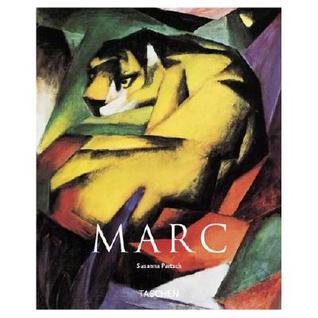
Susanna Partsch’s compact study of Franz Marc reads like a close, lucid argument wrapped in a beautifully produced object: part biography, part formalist reading, part cultural synthesis. Presented in Taschen’s Basic Art series, the volume is deliberately introductory — a short, image-forward guide to an artist whose restless palette and animal imaginaries have become shorthand for German Expressionism.
Partsch’s positioning of Marc is economical and persuasive. She insists, and repeatedly demonstrates, that Marc’s central project was not simply to paint animals as charming subjects but to re-forge perception itself — to make colour and form into a spiritual language capable of expressing a harmonious, universal order. That thesis gives the book its spine: images are read as arguments, colours as moral categories, and animal figures as mediators between the human and the elemental world. The claim is not new, but the prose keeps the exposition focused and the close readings sharp.
Form and method. The author organizes the book chronologically but reads each phase of Marc’s career thematically: early naturalism and draughtsmanship, the encounter with Post-Impressionism and Van Gogh, the formative break toward Cubist simplification, and finally the radical chromatic and symbolic experiments that culminate in the great animals and, paradoxically, in increasingly abstract fields of colour. Throughout, she deploys concise visual analysis — attention to line rhythm, to the internal architecture of a blue horse, to the way a landscape can be elbowed into a spiritual hieroglyph. Her readings are brief but exacting: she locates the compositional pivot points that turn a pastoral into an emblem. The book’s many reproductions (clear, well-printed) allow its analytical sentences to land with real force.
Interpretive strength: chromatic allegory and ethical form. Where Partsch is at her best is in decoding Marc’s colourism as ethical program rather than mere aesthetic whim. Blue, red, yellow: these are not solely optical choices but symbolic coordinates — blue as spiritual tranquility, red as violence or matter, yellow as vivacity — and she tracks how Marc uses these contrasts to stage an ethical cosmos in paint. She reads works such as his equine tableaux and the jagged, atmospheric canvases of 1912–1914 as enacted philosophies: attempts to reorder the visible world into a moral topology. This is a fruitful approach because it restores agency to Marc’s formal choices without imposing anachronistic metaphysics.
Limitations and historiographical caution. The book’s virtues are inseparable from its constraints. At roughly ninety pages and aimed at a general audience, it offers synthesis rather than archival revelation. Readers seeking deep documentary apparatus, extensive footnotes, or new archival discoveries will find the volume wanting: claims are often asserted rather than exhaustively argued, and the bibliography, while serviceable, is selective. For scholars wanting to contest interpretive points — say, the tenor of Marc’s relationship to contemporary mysticism, or the precise dialogues between Marc and Kandinsky — this book is a smart orientation but not a terminal reference. The result is an elegantly argued primer rather than a corrective study.
On tone and pedagogy. Partsch writes with the economy of a lecturer who knows both the specialist literature and how to translate it for new readers. Her sentences balance rigour and readability: there is enough technical vocabulary to satisfy an undergraduate seminar, and enough narrative thrust to keep a general reader engaged. The book’s layout — generous reproductions paired with succinct captions and interpretive paragraphs — makes it ideal for classroom adoption or for the curious museum goer preparing to stand before a Marc on a gallery wall.
This Taschen volume performs its appointed task with intelligence and grace. If one is seeking a compact, image-rich, interpretively confident introduction to Franz Marc — his chromatic experiments, his animal lexicon, and his trajectory toward abstraction — this study is a rewarding first stop. For deeper archival study, one will need move to catalogues raisonnés, exhibition catalogues, and the growing scholarly literature on Der Blaue Reiter; but that movement is precisely the book’s merit: it clarifies what questions are worth pursuing. In short: a lucid primer with real critical insight — recommendable for students, museum visitors, and any reader who wants to understand why Marc’s blue horses still insist on being read as more than pictures.
Discover more from The New Renaissance Mindset
Subscribe to get the latest posts sent to your email.
 The New Renaissance Mindset