
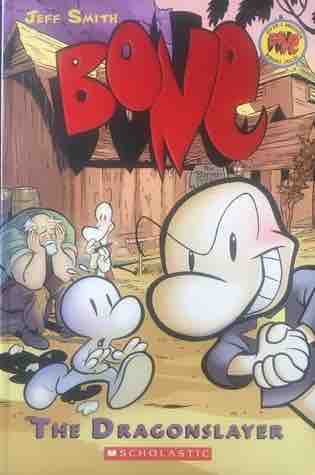
Jeff Smith’s Bone, Vol. 4: The Dragonslayer is the point at which Bone stops feeling merely playful and begins to reveal the moral architecture beneath its comedy. The series has always balanced cartoon buoyancy with old-world menace, but here the writer sharpens that balance into something more intricate: a story about inherited violence, mistaken identity, and the uneasy burden of legend. The volume’s title is brilliant in its irony. “The Dragonslayer” sounds like a heroic assurance, yet Smith treats the very idea of heroism with suspicion. In this world, anyone can be called a slayer; the harder question is whether they understand what they have destroyed.
What gives the volume its force is the way it stages contrast. Fone Bone remains the emotional center—earnest, curious, and often hilariously outmatched—but the narrative around him darkens. Gran’ma Ben’s toughness is more than comic bluster; it becomes a sign of lived survival, a practical wisdom born from dangerous history. Thorn’s presence adds another layer: she is introduced not as a fully legible heroine but as a person whose identity is still unfolding under pressure. Smith is especially good at making revelation feel incremental. Instead of handing out backstory as exposition, he lets character emerge through gesture, hesitation, and confrontation. The result is a story that feels discovered rather than arranged.
The volume also deepens one of the series’ great themes: the instability of appearances. Smith’s visual language constantly reminds us that a friendly face, a goofy expression, or a pastoral scene may conceal threat, grief, or ancient power. The dragons themselves are not simply monsters to be slain; they are symbols of a world whose history exceeds the narrow moral labels imposed on it. The title figure, then, is less a triumphant knight than a mythic misunderstanding. The author uses that misunderstanding to question the stories cultures tell about courage, enemies, and purity.
In that sense, The Dragonslayer is morally more sophisticated than its whimsical surface suggests. The book is full of comic relief, but the jokes are never empty. They create breathing room around fear. Smith understands that laughter can sharpen dread rather than erase it. One of the volume’s quiet achievements is its tonal control: the reader is invited to smile, then suddenly to recognize that the smile has made the danger more vivid. The art helps this enormously. The illustrator’s clean line and expressive staging allow him to move from slapstick to suspense with almost musical precision. His pages are easy to read but difficult to exhaust.
What is most impressive, finally, is how the volume expands the series’ emotional register without losing its accessibility. Bone remains a story of adventure, but it is increasingly a story about memory, inheritance, and the costs of survival. The “dragon” in Smith’s hands is never just a creature; it is a test of interpretation. Who names the threat? Who benefits from the name? Who gets to become a hero in the story afterward?
The Dragonslayer is thus one of the volumes where Bone most clearly reveals its ambition. Beneath the wit and momentum lies a fable about how legends distort reality—and how, occasionally, reality pushes back. It is charming, suspenseful, and quietly unsettling, which is to say that it is exactly the kind of book that lingers after its final page.
Discover more from The New Renaissance Mindset
Subscribe to get the latest posts sent to your email.
 The New Renaissance Mindset
Ah, that sounds good. :-)
LikeLiked by 1 person
Good morning Miranda,
The Bone series is a fun story on many levels. The first book was on a school reading list in an early class for my daughter & I got hooked on the characters… I read them all to her and reread them for myself. It speaks to the kid, the teen, and the adult parts of my E.Q. I easily recommend them. (Most libraries have the series and I’m told they are still very popular)
LikeLiked by 1 person
That’s excellent. It’s great when stories are suitable for every age group. :-)
LikeLiked by 1 person