
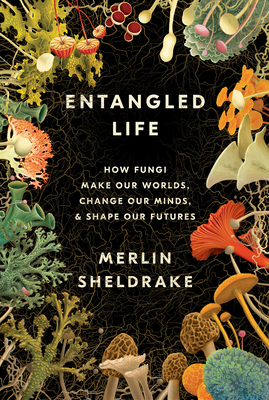
Merlin Sheldrake’s Entangled Life is at once a popular-science exploration, a piece of natural history, and a sustained act of imaginative reorientation. The book’s central achievement is pedagogical and ethical: it trains the reader to look at fungi not as a shadowy footnote in the story of living things, but as a set of processes and relationships that run through ecosystems, economies, minds and cultures. Written with a biologist’s curiosity and a poet’s ear, Sheldrake invites readers to unlearn a certain human exceptionalism and to take seriously the idea that mycelium — the threadlike networks beneath our feet — matter to the shape of life on Earth.
Summary (brief): Sheldrake moves fluidly between microscopic detail and big-picture speculation. He introduces fungal forms and life histories — from mycorrhizal roots to wood-decay fungi, from slime molds (which sit uneasily at the margins of classification) to hallucinogenic species — and uses these vignettes as a scaffold for wider arguments about connectivity, intelligence, and transformation. The book is generous in method: field anecdotes, interviews with mycologists and foragers, lab experiments and lucid explanations of fungal physiology are all marshalled to show how fungi mediate nutrient flows, influence plant behaviour, affect human health and culture, and might point toward novel ways of thinking about cooperation and cognition.
What the book offers (strengths): Its most persuasive move is epistemological. He pushes the reader away from simplistic binary oppositions (individual vs. collective, organism vs. environment) toward a more relational vocabulary. The descriptions of mycorrhizal networks as channels of nutrient exchange that reconfigure plant communities are both concrete and philosophically provocative; they make palpable a model of life where agency is diffuse and material relations are constitutive of subject-hood. The prose is often radiant: sensory details (the smell of fungi, the tactile presence of mycelium) are deployed not merely for ornament but to reconnect cognition to embodied practice. For readers in the environmental humanities, cognitive science, and the arts, Entangled Life supplies a trove of metaphors that are also empirically grounded.
Another strength is the book’s interdisciplinarity. Sheldrake refuses disciplinary solitude: ecology, microbiology, anthropology, history and even aesthetics converse in his pages. This makes the book an unusually fertile source for artists, educators, and policymakers who want a scientifically informed but conceptually generous account of nonhuman life.
Style and narrative voice: The author’s tone is conversational without being breezy — earnest and inquisitive rather than didactic. He loves metaphors, and most of them land; when he anthropomorphizes fungi he usually does so with a self-aware caveat, inviting us to use human terms as an interpretive tool rather than literal description. Structurally the book favours episodic chapters, which makes it pleasurable and accessible for the general reader while retaining enough rigour to satisfy more specialized readers.
Limits and criticisms: A careful reader will notice a creative unevenness. Because the book aims for breadth, some technical claims are presented with a degree of confidence that occasionally questions the available evidence; speculative passages about fungal ‘intelligence’ or the ethical implications of mycelial networks sometimes drift toward metaphor dressed as mechanism. This is a common tension in the best popular science, where the need to provoke wonder can press against the constraints of experimental verification.
There is also an implicit romanticism that runs through the work — a tendency to recast symbiosis as a corrective to modern alienation. That is a powerful rhetorical move, and often justified, yet it risks occluding social, economic and political dimensions of how humans interact with fungi: industries that profit from fungal products, pathogenic impacts on agriculture and public health, or the uneven human costs of biotechnological exploitation. A deeper engagement with those dimensions would complicate the book’s mostly celebratory register and make its call for transformation more grounded in political economy. Perhaps the author will unpack these questions in future editions or follow-up tomes.
Contribution and audience: Entangled Life does what excellent science-writing should do: it reconfigures what we notice in the world and gives readers the cognitive tools to keep noticing. For scholars in environmental humanities or ecological philosophy, it’s a rich source of empirical case-studies and provocative terminology. For artists and educators — readers who, like the book’s likely audience, want to translate ideas into practice — Sheldrake’s balance of precision and lyricism is especially generative.
Sheldrake has written a book that expands both knowledge and imagination. It is not a textbook, nor a manifesto; rather, it is a sustained invitation to revise our ontologies. If the book sometimes flirts with speculative exuberance, that is the price of a work determined to change how we think about being-in-common. Entangled Life is an urgent and capacious contribution to contemporary thinking about ecology and entanglement — recommended for anyone who wants to see the living world in greater depth and with more humility.
Discover more from The New Renaissance Mindset
Subscribe to get the latest posts sent to your email.
 The New Renaissance Mindset