
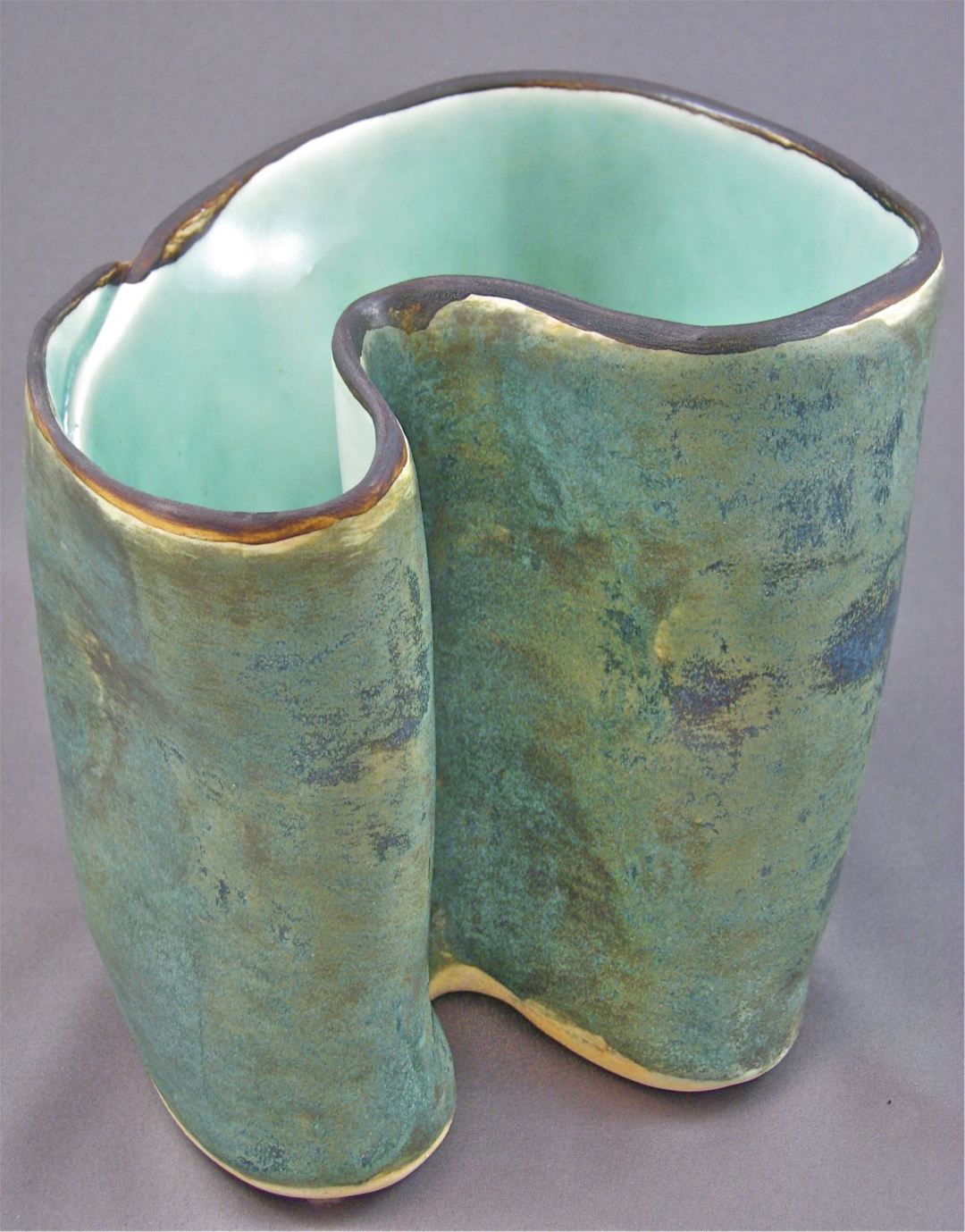
Spontaneous 07-018:
The History: Share what you see and continue the story.
 These somewhat abstract forms are inspired by a love of Raku fired ceramics… I was challenged when a teacher told me it would be nearly impossible to achieve a Raku finish using an electric kiln… so I read a lot on the subject of what happens in Raku firings… it turns out it’s the mistakes that define the amazing results… I focused on what caused those mistakes and used them in creating my finishes. I’m very proud of the results…, especially on the porcelain.
This was done during a summer where I begged for a place to fire my work and was asked to register for a class in turning. I knew I wouldn’t turn, so I made an agreement with the teacher that I would answer any questions the newer students had about finishing their work in exchange for a dedicated space to work. I chose to focus on porcelain and it was loads of fun!
The Technique: How I did this awesomeness!
By this time, I was no longer rolling my slabs, but using a slap-pull technique, where one slaps the clay down with a down and back drag motion. This stretches the clay into a slab shape after several slaps. It allowed me to get remarkably thin and the clay seldom cracked, tore, or bubbled. I usually stacked my slabs in a wet state for weeks under plastic and paper. I would cut the sizes I desired and folded them into rough pots, only using a little water to seal the overlapping ends. I would then use a wooden tool to smooth the inside seams. The bottoms were usually attached with scoring and porcelain slip. My damp sponge smoothing habit took on a whole different effort with the fine particles of the porcelain. I had to rinse the sponge much more often, but the surface tool on a slight slip-coat texture. It was beautiful. It went to bisque when dry.
To glaze it, I decided to continue mixing glazes with a brushing on technique. I painted on thin coats, alternating between matte white and a glossy glaze, in this case, Variegated Blue. I ripped off any excess from the Botton and took all the glaze off the upper rim, then painted on an oxide, knowing it could cause the glaze to pool away or do some other odd effect. In most of these, it only tinted the rim.
The Influence: Confessions of a Plagiarist, sort of…
This book pulled me over to my love of the Wabi-Sabi aesthetic: 500 Raku: Bold Explorations of a Dynamic Ceramics Technique by Ray Hemachandra, Jim Romberg
Pick the red pill or the blue pill When you buy The Artist’s Stuff: Prints, Mugs, T-Shirts, Pillow, Shower Curtains, and other awesome stuff.
Books that Inspired and Influenced my Experimentation:
These are perhaps the most obvious influences, but the truth is that my influences run deep through thousands of books and works I’ve seen & read. If you have the time, you are free to visit my GoodReads library to see a fraction of the books I’ve read. These are the ones I remember, that is. Or you can visit the ever growing collection on my Pinterest account.
Electric Kiln Ceramics: A Guide to Clays and Glazes by Richard Zakin
Working with Clay by Susan Peterson
The Craft and Art of Clay by Susan Peterson
Slab-built Ceramics by Coll Minogue
The Art of Handbuilt Ceramics by Susan Bruce
Mastering Raku: Making Ware * Glazes * Building Kilns * Firing by Steven Branfman
500 Raku: Bold Explorations of a Dynamic Ceramics Technique by Ray Hemachandra, Jim Romberg
500 Vases: Contemporary Explorations of a Timeless Form by Ray Hemachandra (Editor), Julia Galloway
Masters: Earthenware: Major Works by Leading Artists by Ray Hemachandra (Editor), Matthias Ostermann
500 Ceramic Sculptures: Contemporary Practice, Singular Works by Suzanne J.E. Tourtillott
The Unknown Craftsman: A Japanese Insight Into Beauty by Soetsu Yanagi, Bernard Leach (Adapted by), Shoji Hamada (Foreword)
Utopic Impulses: Contemporary Ceramics Practice by Amy Gogarty
Craft Perception and Practice, Volume 2: A Canadian Discourse by Paula Gustafson
Craft Perception and Practice: A Canadian Discourse, Volume 1 by Paula Gustafson
Decorating Techniques (Ceramics Class) by Joaquin Chavarria
20th Century Ceramics by Edmund de Waal
The Figure in Clay: Contemporary Sculpting Techniques by Master Artists by Lark Books, Suzanne J.E. Tourtillott
Japanese Wood-Fired Ceramics by Marc Lancet
Contemporary Clay: Japanese Ceramics for the New Century by Joe Earle
500 Figures in Clay: Ceramic Artists Celebrate the Human Form by Veronika Alice Gunter
Ceramic Design Course: Principles, Practice, and Techniques: A Complete Course for Ceramicists by Anthony Quinn
Wabi Sabi: The Japanese Art of Impermanence by Andrew Juniper
500 Plates & Chargers: Innovative Expressions of Function & Style by Suzanne J.E. Tourtillott
500 Pitchers: Contemporary Expressions of a Classic Form by Suzanne J.E. Tourtillott
500 Tiles: An Inspiring Collection of International Work by Suzanne J.E. Tourtillott
500 Animals in Clay: Contemporary Expressions of the Animal Form by Suzanne J.E. Tourtillott
Masters: Porcelain: Major Works by Leading Ceramists by Lark Books
500 Cups: Ceramic Explorations of Utility and Grace by Suzanne J.E. Tourtillott
Llorens Artigas by Pierre Courthion
Alternative Kilns & Firing Techniques: Raku * Saggar * Pit * Barrel by James C. Watkins, Paul Andrew Wandless, Lark Books
The Teapot Book by Steve Woodhead
Studio Ceramics in Canada, 1920-2005 by Gail Crawford
Potter’s Guide to Ceramic Surfaces by Jo Connell
The Ceramic Glaze Handbook: Materials, Techniques, Formulas by Mark Burleson
Fired Up with Raku: Over 300 Raku Recipes by Irene Poulton
Isamu Noguchi and Modern Japanese Ceramics: A Close Embrace of the Earth by Louise Allison Cort, Bert Winther-Tamaki
Modern Japanese Ceramics: Pathways of Innovation & Tradition by Anneliese Crueger, Wulf Crueger, Saeko Ito
Potters Manual: Complete, Practical Essential Reference for All Potters by Kenneth Clark
The Soul Of A Bowl: Don Reitz, Frank Boyden, Jenny Lind, Tom Coleman, Elaine Coleman by Contemporary Crafts Museum & Gallery
Salt-Glaze Ceramics by Rosemary Cochrane
Robin Hopper Ceramics: A Lifetime of Works, Ideas and Teachings by Robin Hopper
Slab Techniques (Ceramics Handbook) by Jim Robison, Ian Marsh
Sculptural Ceramics by Ian Gregory
Ceramics for Beginners: Surfaces, Glazes & Firing by Angelica Pozo
Handbuilt Ceramics: Pinching * Coiling * Extruding * Molding * Slip Casting * Slab Work by Kathy Triplett, Lark Books
Painting on Ceramics by Kate Byrne
The Penland Book of Ceramics: Master Classes in Ceramic Techniques by Lark Books
Ceramics for Beginners: Animals & Figures by Susan Halls
Ceramics for Beginners: Hand Building by Shay Amber
Ceramics – Ways of Creation by Richard Zakin
Surface Design for Ceramics by Maureen Mills
The Materials: Quick! Order this stuff right now, AND You too can make masterpieces!
Pottery supplies:
Clays: I’ve used mostly Cone 6 clays from Pottery Supply House:
The ones I’ve used the most are:
CONE 6 PORCELAIN: The Review: This was a challenge to use. One needed to work it faster because if it dried too fast, it would crack. It’s elasticity while in the wet-leather hard stage was fun to play with and allowed to melting appearances. It took stains very well and loved my pure pigment glazes.
Glazes:
These were usually private mixes from the studios I worked in. I never asked for the recipes. When I graduated to the private studio, under the mentorship of porcelain master Marie Cote, I used her clear glaze as the base for all my experimentation and mixes. It was the most robust and versatile glaze available and allowed me to mix in pure pigments and metals without runoff or kiln incidents. Make sure to ask your local supplier for a stable clear glaze and play with it.
Stains, Engobes, & Underglazes:
Most of these come from Pottery Supply House or Sial. This is where you need to play a little.
These are the ones I’ve played with the most to make my own:
6005 – Pigment – Crimson – 125gr:
6025 – Pigment – Coral Red -125gr:
6305 – Pigment – Teal Blue – 125gr:
6300 – Pigment – Mazerine Blue – 125gr:
6385 – Pigment – Pansy Purple – 125gr:
6464 – Pigment – Zirconium Yellow – 125gr:
K648 – Pigment – Dark Green:
H378 – Pigment – Amber:
R140 – Pigment – Camel Brown:
431 – White – Opaque Stain:
454 – Rust – Opaque Stain:
476 – Black – Opaque Stain:
475 – Charcoal – Opaque Stain:
953 – Bronze:
954 – Copper:
956 – Silver:
958 – Blue:
You can play with Other Raw Pigments, but make sure you ask for what’s in them & if they can mix with your glazes. Certain minerals and metals will cause your glazes to crackle or drip off the surface during firing, and some may cause explosions.
Pottery Tools:
You can get these awesome starter kits:
1- niceEshop 30pcs Clay Sculpting Tools Pottery Carving Tool Set Wooden Handle Modeling Clay Tools with Pouch Bag
2- Celendi Professional Sculpture Carving Tool Set: The review: Both of these sets give you a vast range of possibilities for turning, handbuilding, carving, trimming, and marking.
Some of my tools come from Pottery Supply House or Sial. Some I made myself. Marking tools really come from your imagination and almost anything can be used. You can spend a small fortune for them or make them yourself. You can get loads of materials from the dollar store to make them.
Brushes & applicators:
I found that Calligraphy Brushes & Bamboo Brushes worked the best and I indulged in a variety of big ones. They hold much more glaze and helped me achieve more uniform coatings when I wasn’t dipping the bisqued pieces. They also allowed me the finer tips for greater details when wanted.
You can easily get squeeze bottles from the dollar store, but the drip control is better with pro tools.
If you are uncertain of what to get, simply order a few or all of the following:
Note: Some of these brushes can be found at local art supply stores as well.
Miscellaneous: I also mixed into my glazes and onto the surface of my clays, asphalt, beach sand, glass beads & marbles, gold, silver, & copper wire, and a variety of metal dust. Some came from pottery supply houses, some from hardware stores, some simply found.
Warning: I don’t suggest you use any of these without supervision, or the go ahead from an experienced kiln technician or master potter. Some of these release gases in the kiln that causes other glazes to change color, drip off the pieces, and they may even explode in the kiln. I used my knowledge of chemical reactions combined with the careful study of firing mistakes to create my results. And, I always had the benefit of masters advising me on the potential dangers.
Photoshop for Mac: The Review: You could use the free “ MAC Photos” program or Picassa and get similar results, but Photoshop offers you the flexibility of presenting yourself as a pro photographer, like no other program. There’s a reason it’s considered the best of the best, after all. So, this allows you the possibility of selling this service to others and funding more of your creativity
Apple MacBook Pro 15.4″ Laptop: The Review: You may choose to get an iMac for the bigger screen, and I couldn’t disagree with the beauty of working with the 24” screen. I picked the laptop, because of the need to be mobile and the flexibility of multi-purposing it to use for client demos. As an alternative to the weight of this model, I would suggest the MacBook Air 13”. Most of us have become accustomed to mobile device size screens and it is much easier to carry around.
Camera: Canon EOS Rebel T6 DSLR: The Review: My first DSLR camera was the EOS Rebel T3. This one is vastly superior to the old model. Canon has a well-deserved reputation of having top rated cameras. It requires a little play time to master it, and that time will be lessened by defining a clear idea of what you want to do with it, then jumping on YouTube for the multitude of How To videos. If you want a smaller camera to carry around, try Canon EOS M10 Mirrorless Digital Camera OR go small & powerful with the Canon PowerShot Digital Camera with 3-Inch LCD & built in wifi.
Canon PIXMA MX492 Inkjet Printer: The Review: For me, this has been the easiest to use for cleaning and cartridge replacement. It works reasonably well with recycled inks and the wireless is easy to set-up. The Canon has worked best for me on ink usage. When purchasing printers, always consider the cost of ink replacement… for the most part, this is the big difference right now in printers. For big reproduction lines, it is better to outsource. For scanning, they are as good as the camera in them… this is one reason I’m a fan of Canon products. It does do a nice job on printing photos on good photo paper, and the black print is crisp and clean, provided you do regular cleanings and keep it dust free.
Discover more from The New Renaissance Mindset
Subscribe to get the latest posts sent to your email.
 The New Renaissance Mindset
So much inspiration here! Thank you for sharing. I love the finish on the featured work, and also the name of the book “Soul of a Bowl”!
LikeLike