
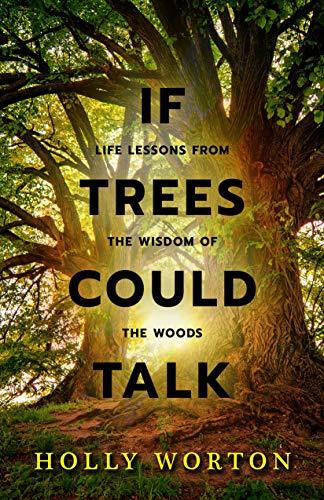
Holly Worton’s If Trees Could Talk artfully weaves poetic reflection, personal narrative, and ecological insight into a tapestry that encourages readers to listen more attentively to the natural world. At once intimate and expansive, Worton’s prose invites us to regard trees not merely as silent sentinels of our landscape but as teachers bearing vital lessons about resilience, interconnectedness, and the cycles of life.
Synopsis and Structure
The book unfolds in loosely connected chapters, each centered on a particular “lesson” drawn from the lives of trees—ranging from patience and rootedness to transformation and letting go. Worton often begins with an anecdote—perhaps a childhood memory under an ancient oak or her observations of saplings sprouting after a forest fire—and then extrapolates a broader life lesson. Interspersed throughout are passages of lyrical description: the veined pattern of a leaf, the undertones of moss on bark, the hush of dusk in a beech grove. These evocative sketches ground the conceptual reflections in vivid, sensory detail.
Thematic Resonances
One of the book’s greatest strengths lies in its ability to move effortlessly between the micro and the macro. A meditation on the wood-wide mycorrhizal network (“the Wood Wide Web,” as Worton terms it) becomes an allegory for community, mutual support, and unseen bonds among people. Likewise, the tenacity of pioneer species colonizing a burned landscape prompts us to reconsider the meaning of failure and renewal in our own lives.
Worton’s approach echoes—and at times consciously nods to—the transcendentalist tradition: Emerson and Thoreau loom in the background, reminding us that self-discovery is inseparable from communion with nature. Yet she avoids mere pastiche; her voice remains distinctively contemporary, suffused with gentle humor and grounded in scientific curiosity. This balance prevents the text from slipping into either didacticism or sentimental pastoralism.
Style and Scholarship
Although accessible, Worton’s language bears the careful precision of a scholar. Botanical terms are introduced with clarity and context, never alienating the lay reader but enriching the texture of her observations. Footnotes and brief references to studies—on tree cognition, communication, and longevity—lend intellectual rigor without weighing down the narrative flow. This blend of scientific grounding and poetic flourish positions If Trees Could Talk as both a memoiristic journey and a light primer on forest ecology.
Her sentences, often gently rhythmic, evoke the measured pace of a forest promenade. She writes, for instance, of “roots twisting like the fingers of a first-grader discovering the world” or describes the treetops’ canopy as “a cathedral of green where light itself seems to kneel.” Such turns of phrase underscore her conviction that language—and by extension, human consciousness—can draw sustenance from the living world.
Significance and Takeaway
In an era when environmental crisis looms large, Worton’s book offers a counterpoint of deep attention rather than alarm. She does not shy away from acknowledging deforestation, climate change, or habitat loss; rather, she places these urgencies within a broader moral imperative to rekindle our sense of kinship with nonhuman life. Her closing chapters, meditating on legacy and the seeds—both literal and metaphorical—that we leave behind, resonate as a quiet call to stewardship.
For readers seeking both solace and challenge, If Trees Could Talk serves as an invitation to slow down, to observe the intricate dialogues of forest life, and to apply those insights—rootedness, patience, mutual aid—to the tangled thickets of human existence.
Holly Worton’s If Trees Could Talk succeeds admirably as a reflective, well-researched work of nature writing. It occupies the fertile ground between memoir, natural history, and philosophical meditation, yielding a text that feels urgent yet unhurried. Drawing on both scientific study and lyrical imagination, Worton offers readers a nourishing encounter with the wisdom of the woods—and, by extension, a path toward deeper empathy and resilience in their own lives.
Discover more from The New Renaissance Mindset
Subscribe to get the latest posts sent to your email.
 The New Renaissance Mindset