
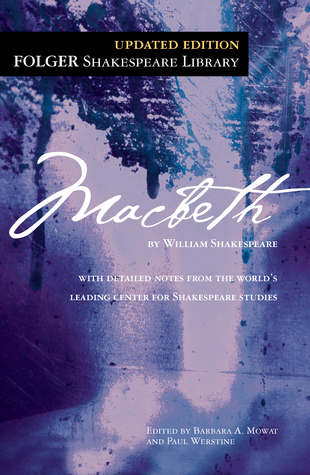
Macbeth is a compact, volcanic tragedy: a play in which Shakespeare concentrates moral, psychological, and political energy into a span of action so compressed that every word feels charged. At its heart is an ethical experiment — what happens when a capable man is offered power by a fate he cannot fully control and a partner who will unmake the last restraints of his conscience. The result is less a succession of events than a progressive disintegration: of identity, of kingship, and of language itself.
Power, prophecy, and the moral engine
The play opens with the witches’ paradox, a short sentence that does enormous work: “Fair is foul, and foul is fair.” (Act 1, Scene 1). That couplet is not mere atmosphere; it names Macbeth’s moral climate. The prophetic structure of the plot — the weird sisters’ glimpses of a possible future — forces Macbeth into an agonizing relation with chance and choice. His speeches after the prophecies (notably the dagger soliloquy: “Is this a dagger which I see before me” — Act 2, Scene 1) stage the boundary between inward temptation and outward action: hallucination, imagination, and the rhetoric of justification converge into the single violent moment that defines the tragedy.
Ambition, gender, and the dynamics of persuasion
A distinguishing feature of this play is the way persuasion is staged. Lady Macbeth’s rhetoric — ruthless, performative, and unnerving — operates as the play’s catalytic force. After the murder, Shakespeare renders guilt in a series of theatrical, image-rich fragments: “Out, damned spot!” (Act 5, Scene 1) and “All the perfumes of Arabia will not sweeten this little hand” (Act 5, Scene 1) compress the workings of conscience into a few stark metaphors. The play interrogates gender not by issuing doctrine but by dramatizing who takes rhetorical control: Lady Macbeth invokes brutalized masculinity to prod Macbeth; Macbeth, in turn, increasingly loses rhetorical command as his interior life unravels.
Language, meter, and imagery
Shakespeare’s formal choices mirror psychological collapse. The witches’ chant-like lines and abrupt couplets set an uncanny tone; Macbeth’s great soliloquies (the dagger speech, the “tomorrow” meditation) deploy blank verse that swells, stumbles, and finally erodes. Consider Macbeth’s late meditation on existence: “Tomorrow, and tomorrow, and tomorrow” (Act 5, Scene 5) — the repetition becomes a machine for despair, a prosodic imitation of time’s petty, grinding advance. Recurring images — blood, sleep, darkness, and clothing — function as a semantic network. “Sleep” in particular becomes a moral noun and a dramatic device: murder interrupts sleep, and the desire to sleep (or to be immune from sleep’s restorative function) marks the characters’ alienation from human consolation.
Stagecraft and compression
Structurally, Macbeth is lean. There are fewer incident scenes than in many Shakespearean plays, and this economy heightens intensity: scenes collide and images ricochet. The play’s theatricality — apparitions, visions, offstage violence — insists that the stage be an imaginative forum for interior states. Directors and actors have long exploited this economy: the quick arc from prophecy to regicide invites a performance style that privileges tempo, silence, and the charged pause.
Moral ambiguity and historical resonance
While the play is often read politically — as an exploration of kingship, legitimacy, and regicide — its power is also psychological. Shakespeare refuses a simple moral ledger: Macbeth is not merely a villain, and Lady Macbeth is not wholly monstrous. Their mutual undoing suggests a shared culpability: ambition is contagious and language is complicit. The play’s continued resonance rests on this ambiguity: its dilemmas are not solved by exposition but lived, in bleak, eloquent detail.
As a study of ambition and the fragility of civic and personal order, Macbeth is ruthlessly effective. Its brevity sharpens its paranoia; its images lodge in the mind; its speeches dramatize a moral psychology that feels modern in its concentration on interior causality. For scholars and readers who prize the intersection of rhetoric, psychology, and political anxiety, Macbeth offers inexhaustible returns: every line is both performance and proof, a speech act that advances character and unmasks conscience.
Recommendation: read it aloud, attend to the silences as much as to the words, and look closely at how Shakespeare makes moral collapse sound — for in Macbeth, language itself becomes the scene of the crime.
Discover more from The New Renaissance Mindset
Subscribe to get the latest posts sent to your email.
 The New Renaissance Mindset
Very nice.
LikeLiked by 1 person
Thank you
LikeLiked by 2 people