
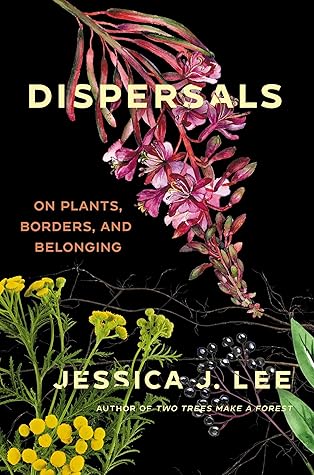
In this spare, luminous collection, Jessica J. Lee knits together memoir, archival history, and ecological criticism to ask one persistent question: what do we mean when a living thing is said to be “out of place”? The book’s fourteen interlocking essays—ranging in register from close natural observation to cultural history—treat plants not as background scenery but as actors whose movements illuminate human migrations, empire, and belonging. The volume was first published in North America by Catapult in 2024.
Formally, Dispersals is careful and cumulative. Each essay reads like a lens turned on a different specimen (giant hogweed, soy, kelp, cherry blossoms appear throughout the book), but rather than aggregating discrete case-studies the essays refract one another: personal recollection and family migration recur alongside botanical lineages and colonial trade routes. Lee’s editorially curated arrangement—visible in the table of contents—makes the collection feel excavatory: small, exact pieces that together produce a larger map of movement and belonging.
The author’s rhetoric is notable for its restraint and precision. She opens the volume with a programmatic question—“What happens when a plant—or a people—moves from one place to another?”—which functions less as an abstract prompt than as an ethical instrument, shaping how the reader evaluates familiar terms such as “invasive,” “native,” and “exotic.” That line announces a double aim: to unsettle received ecological categories and to draw parallels between botanical histories and human displacement. The book repeatedly shows how language—scientific, horticultural, bureaucratic—frames moral judgements about mobility.
On close reading, we can consider how Lee transforms the commonplace into the uncanny. Writing on domestic memory and migration she observes that “plants illuminate facets of life and our world—whether personal, political, ecological, scientific, or otherwise.” This sentence is exemplary of her method: a declarative observation whose scope telescopes from a single leaf to questions of empire and care. (Short quotation used above.)
Another rhetorical move is the use of modest, embodied scenes—kitchen window-hangings, walks on tidal flats—to pivot into wider histories. These small anchorages lend ethical pressure to her archival lyricism: an essay about soy, or about kelp, will move from family table to nineteenth-century trade documents to contemporary debates about “baseline” ecology, and the transitions feel earned rather than didactic. Critics have praised this blending of memoir and research; reviewers note how Lee’s prose remains “crystalline” even as it negotiates complex historiographies.
Where the book is most provocative is in its political insistence that many of our ecological categories are inflected by imperial histories. By tracing how plants were moved, named, and legislated, we are shown how botanical vocabularies were (and are) used to police human mobility as well—an argument that resonates through the collection and reframes “invasive” as a contested, historically specific judgement rather than a neutral scientific fact. This repositioning is one of the book’s lasting contributions to nature writing: it steadies ecological attention while refusing consolatory nostalgia for any imagined “pristine” landscape.
Tone and audience: Lee writes for readers who appreciate both close observation and rigorous context. Her sentences are often compact and unsentimental; when the book turns elegiac it does so through accumulation rather than melodrama. The essays’ ethical urgency—about what we cultivate, protect, or vilify—pairs well with their stylistic discipline. Early reviewers and cultural outlets recognized the book’s achievement: Dispersals was shortlisted and otherwise highlighted in prize and editorial circles soon after publication.
Limits and caveats: the book is intentionally partial—Lee admits she is not an ecologist or horticulturalist—and some readers may wish for a deeper engagement with ecological modelling or field science. But that relative restraint is also a strength: by situating botanical knowledge within cultural and imperial frameworks, Lee enlarges the conversation that strictly scientific accounts might narrowly circumscribe.
Verdict: Dispersals is a quietly radical work of nature writing. It remodels our metaphors for movement, asks that we read plants and people together, and demonstrates how close attention can produce political insight. For scholars of environmental humanities and for curious readers who want nature writing that thinks historically and ethically, this collection is indispensable. If you want to dip in first, start with the opening “A Note to the Reader” and then move to the titular essay—Lee’s capacious curiosity rewards both close rereading and slow, unhurried reflection.
Discover more from The New Renaissance Mindset
Subscribe to get the latest posts sent to your email.
 The New Renaissance Mindset