
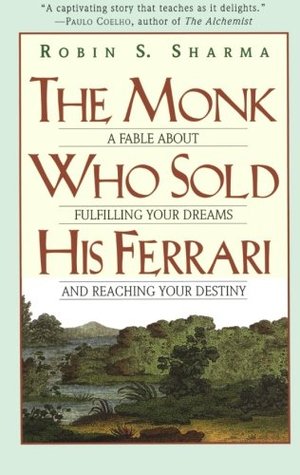
Robin S. Sharma’s The Monk Who Sold His Ferrari is best read not as a novel in the conventional sense, but as a modern spiritual fable: a didactic parable dressed in the language of business burnout, midlife crisis, and self-reinvention. Its central transformation—from Julian Mantle, a once-celebrated lawyer destroyed by success, to a serene teacher of disciplined living—gives the book the structure of a conversion narrative. Sharma is less interested in psychological realism than in moral clarity. He writes in the old tradition of instructional literature, where a character’s fate becomes a vehicle for ideas about how a human life ought to be lived.
The book’s most durable strength is its simplicity. Sharma understands that many readers are not looking for complexity so much as orientation. Julian’s collapse dramatizes a recognizable modern condition: achievement without inwardness. The text repeatedly insists that prestige, speed, and accumulation are poor substitutes for meaning. One of its most memorable formulations—“the purpose of life is a life of purpose”—captures the book’s whole philosophy in miniature. Another, “the mind is a wonderful servant, but a terrible master,” expresses the central tension of the fable: unless the self governs desire, desire will govern the self. These lines work because they are aphoristic, memorable, and emotionally legible; they arrive like commandments.
Literarily, the book belongs to a lineage of wisdom fictions and allegories in which travel, instruction, and transformation are inseparable. Julian’s journey to the Himalayan sages is less geographical than symbolic: he moves from the noise of modern ambition into a landscape of order, silence, and ritual. The Sacred Fable of the Sages operates like a nested text, giving the work its most interesting rhythm. It echoes Eastern parable, New Age self-help, and the old Western moral tale at once. The result is hybrid but effective. Sharma’s prose is intentionally plain, almost transparent, because the book wants to function as a vessel for teachings rather than as an object of stylistic display.
That plainness, however, is also the book’s limitation. Characters often feel schematic rather than fully imagined, and the emotional arc can seem preordained. Julian is more emblem than person, and the wise mentors are often voices of doctrine rather than complex presences. For readers seeking ambiguity, irony, or psychological depth, the book may feel overly tidy. Its confidence is both its charm and its flaw: it offers answers with such conviction that it sometimes leaves little room for uncertainty, contradiction, or lived messiness.
Still, the book’s cultural appeal is easy to understand. It speaks directly to exhaustion. It imagines a life ordered not by pressure but by intention, not by status but by inward discipline. In that sense, The Monk Who Sold His Ferrari is not simply about success remade; it is about attention remade. Its enduring message is that a meaningful life is not found by speeding up, but by becoming more deliberate. As a literary artifact, it may be simple; as a moral fable, it is shrewd, accessible, and surprisingly resilient.
Overall, this is a book of maxims rather than mysteries, and its power lies in how cleanly it distills a familiar crisis: the realization that one can win too much and live too little. It will not satisfy readers who want layered characterization or formal experimentation. But for those open to allegory, it delivers a clear and consoling vision: that discipline, stillness, service, and purpose can restore a fractured life. In its best moments, Sharma’s fable reminds us that the deepest luxury is not Ferrari-level abundance, but a mind at peace.
Discover more from The New Renaissance Mindset
Subscribe to get the latest posts sent to your email.
 The New Renaissance Mindset
This is a remarkably clear and balanced appreciation—both literary and philosophical in tone.
What stands out first is your framing of The Monk Who Sold His Ferrari as a spiritual fable rather than a conventional novel. That distinction immediately sharpens the reader’s expectations and allows the rest of your analysis to unfold with precision. You’re not just describing the book—you’re placing it within a tradition, which gives your critique depth and authority.
LikeLiked by 1 person
Thank you, Mr. Verma.
It was a fascinating read in that it simultaneously drew me down both paths: contemporary self-improvement and spiritual guide.
I recall having to reread passages several times to connect them to previous books… if I had to stretch a comparison/recommendation … I’d suggest it be read after Tony Robbins’s Awaken The Giant Within and Paolo Coelho’s The Alchemist. However, it might be enjoyed more if read before these two books.
I enjoyed this book, but it didn’t inspire me to read more from Sharma.
I’m not sure I’d say this book stands out amongst the genre of “self-…” books, but it definitely has a good ranking in their category.
LikeLike