
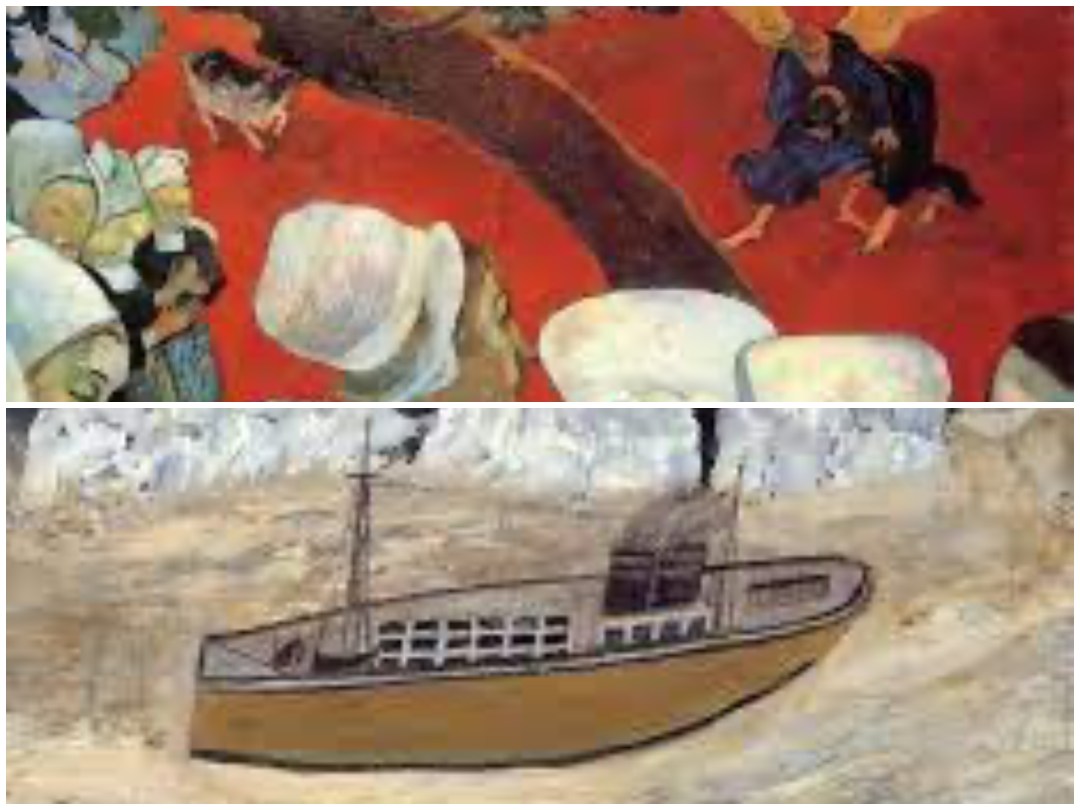
Art is a creative expression of the artist’s emotions, experiences, and perceptions. Two artworks from different periods are compared and contrasted in this paper. The two artworks are the 1888 primitivist artwork, “Vision After the Sermon” by Paul Gauguin, and the 1936 naive art artwork, “Voyage to Labrador” by Alfred Wallis.
Paul Gauguin’s “Vision After the Sermon” and Alfred Wallis’s “Voyage to Labrador” are both examples of non-academic art movements. The former is an example of primitivism, while the latter is an example of naive art. The two paintings differ in many ways, including their style, content, and subject matter.
Paul Gauguin’s “Vision After the Sermon” is a primitivist artwork created in 1888. The painting depicts Breton women who have just attended a sermon. They are shown with their eyes closed, meditating on the sermon’s message. Gauguin uses bold, flat planes of colour to create a sense of abstraction, and the painting is characterized by its strong lines and contrasting colours. Gauguin was inspired by the primitive art of Polynesia, and he believed that the art of the primitive people was more sincere and authentic than the art produced by the Western world.
Alfred Wallis’s “Voyage to Labrador,” on the other hand, is a naive art artwork created in 1936. The painting depicts a ship sailing on the sea, and it is characterized by its simple, childlike style. The painting is created with a limited colour palette, and the forms are flat and two-dimensional. Wallis was a self-taught artist who lived in a fishing village in Cornwall. He was inspired by the sea and the ships that sailed on it, and he created many paintings that depicted these subjects.
One of the main differences between the two artworks is their style. “Vision After the Sermon” is characterized by its bold, flat planes of colour and strong lines, while “Voyage to Labrador” is characterized by its simple, childlike style and two-dimensional forms. Another difference between the two artworks is their content. “Vision After the Sermon” depicts a religious scene, while “Voyage to Labrador” depicts a ship sailing on the sea.
Discover more from The New Renaissance Mindset
Subscribe to get the latest posts sent to your email.
 The New Renaissance Mindset