
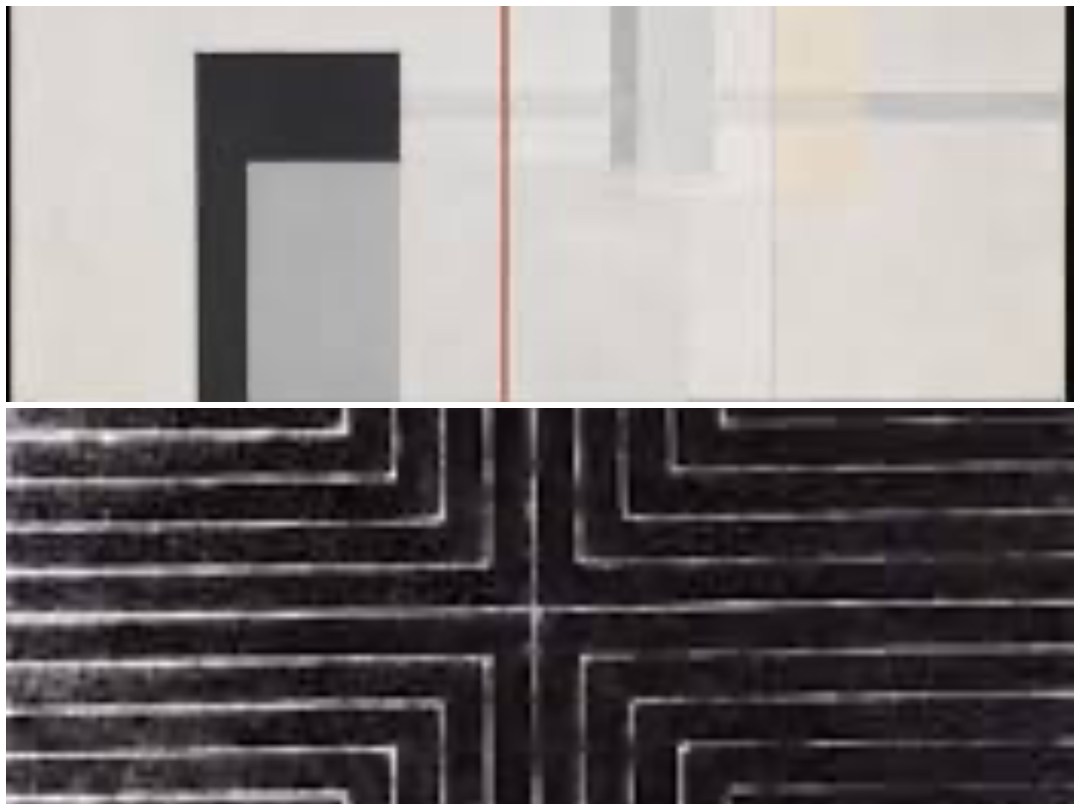
The art world of the 20th century witnessed the emergence of various artistic movements that challenged traditional norms and conventions. Minimalism (a sub-ism of Abstract Expressionism) and Modernism (a similar ism to Constructivism) were two influential movements that sought to redefine the boundaries of artistic expression. Frank Stella’s “Die Fahne Hoch!” and Laszlo Moholy-Nagy’s “K VII” exemplify the distinctive characteristics of these respective movements. This paper endeavours to provide a comprehensive comparative analysis of these artworks, exploring their formal elements, conceptual frameworks, and historical contexts.
Frank Stella’s “Die Fahne Hoch!” is a large-scale painting characterized by bold and vibrant geometric forms. The artist employs flat areas of colour, sharp lines, and precise geometric shapes to create a sense of dynamism and visual tension. In contrast, Laszlo Moholy-Nagy’s “K VII” showcases a more restrained and minimalist approach. The composition consists of intersecting lines, transparent planes, and overlapping geometric shapes, resulting in a harmonious and balanced visual arrangement. Both artworks utilize colour and form to evoke a sense of movement and spatial depth, albeit employing different techniques and approaches.
Stella’s “Die Fahne Hoch!” embodies the spirit of Abstract Expressionism, emphasizing subjective expression and emotional intensity. The artist’s use of a bold colour and gestural brushstrokes reflects the movement’s focus on individual expression and the primacy of the artist’s inner world. On the other hand, Moholy-Nagy’s “K VII” exemplifies the principles of Constructivism, which emphasizes rationality, objectivity, and the integration of art with technology. The painting reflects Moholy-Nagy’s belief in the social and functional potential of art, employing geometric abstraction to create a visual language that transcends individual expression.
Frank Stella’s “Die Fahne Hoch!” was created during a period when Abstract Expressionism and its sub-isms dominated the American art scene. This movement emerged in the aftermath of World War II and aimed to convey the anxieties and existential concerns of the post-war era. Stella’s work, with its bold colours and aggressive brushwork, reflects the movement’s emphasis on personal expression and the artist’s subjective experience. In contrast, Laszlo Moholy-Nagy’s “K VII” was painted decades later, during a time when Constructivism had already made a significant impact. Moholy-Nagy, a prominent Bauhaus artist, sought to integrate art, technology, and industry. “K VII” exemplifies his vision of art as a tool for social progress, embodying the ideals of the Constructivist movement.
Through a comparative analysis of Frank Stella’s “Die Fahne Hoch!” and Laszlo Moholy-Nagy’s “K VII,” it becomes evident that these artworks embody the distinctive characteristics of Minimalism and Modernism, respectively. Stella’s painting emphasizes subjective expression and emotional intensity, employing bold colours and gestural brushwork, while Moholy-Nagy’s work reflects the principles of rationality and functionalism, employing geometric abstraction and transparency. By examining the formal elements, conceptual frameworks, and historical contexts of these paintings, we gain insight into the diverse approaches taken by artists of different eras, shedding light on the ever-evolving nature of artistic expression.
Discover more from The New Renaissance Mindset
Subscribe to get the latest posts sent to your email.
 The New Renaissance Mindset