
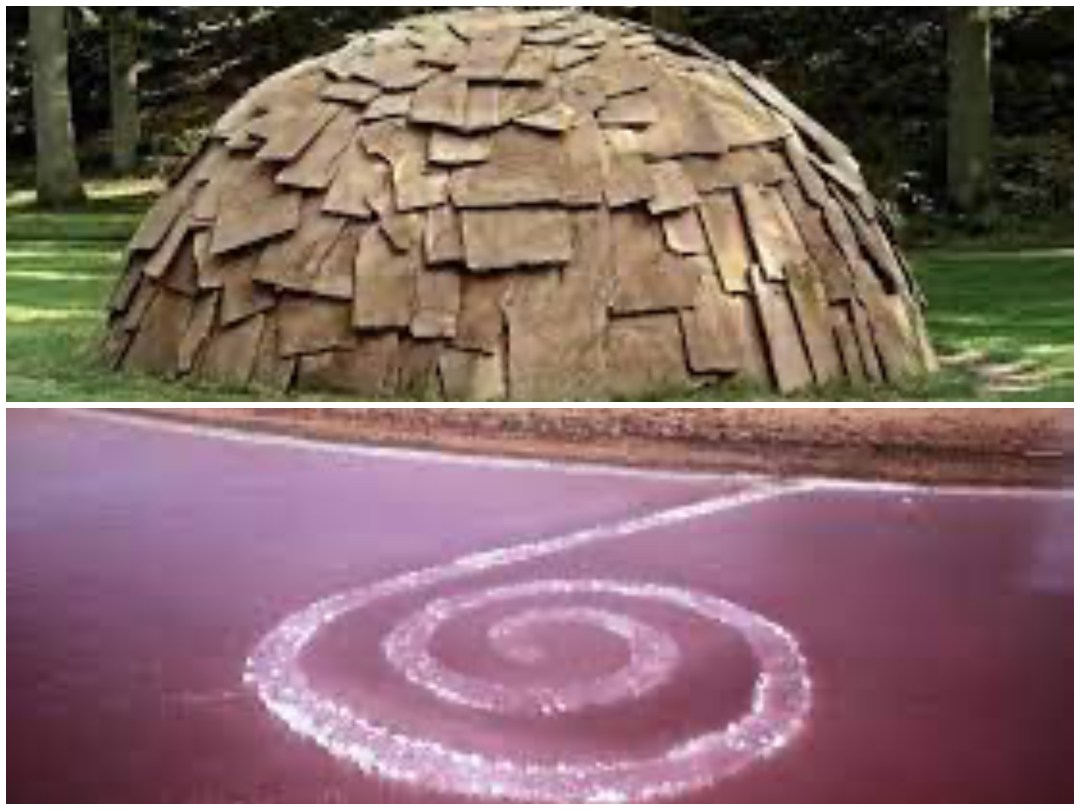
Artistic production during the late 1960s and early 1970s witnessed a surge in experimental and unconventional approaches. Two artworks that epitomize this trend are Mario Merz’s “Igloo of Stone” and Robert Smithson’s “Spiral Jetty.” While both artists explore themes of nature, temporality, and site-specificity, their works diverge in terms of materiality, form, and context. This paper will delve into a comparative analysis of these two seminal artworks, shedding light on their distinct artistic visions and contributions.
Merz’s “Igloo of Stone” comprises a structure made of stacked stones with a neon light protruding from its centre. This juxtaposition of organic and industrial elements exemplifies Merz’s exploration of the dichotomy between nature and culture. In contrast, Smithson’s “Spiral Jetty” is a massive earthwork in the shape of a spiral, constructed using rocks, mud, and salt crystals. The artwork’s sprawling, dynamic form reflects Smithson’s interest in the relationship between geological time and artistic practice. Merz’s focus on the interaction between natural and artificial materials contrasts with Smithson’s engagement with geological processes and the primordial landscape.
Merz’s “Igloo of Stone” embodies a sense of impermanence and fragility. Its stone structure appears delicate and transient, reminiscent of the transient nature of human existence. In contrast, Smithson’s “Spiral Jetty” is rooted in the geological timescale, with its construction materials and location subject to the forces of nature. The artwork’s endurance against natural erosion underscores Smithson’s exploration of deep time and the interplay between human intervention and natural entropy.
Merz’s “Igloo of Stone” can be installed in various environments, adapting to different contexts and engaging in a dialogue with the surrounding landscape. The artwork’s neon light illuminates the structure, creating a striking visual contrast against the organic materials. In contrast, Smithson’s “Spiral Jetty” is intimately tied to its specific location in the Great Salt Lake, Utah. The spiral form and the artwork’s interaction with the lake’s ebb and flow establish a profound connection between the land and the artwork, emphasizing site-specificity as an integral aspect of Smithson’s practice.
In conclusion, a comparative analysis of Mario Merz‘s “Igloo of Stone” and Robert Smithson‘s “Spiral Jetty” highlights the distinct approaches these artists employed to explore themes of nature, temporality, and site-specificity. Merz’s work embodies the interplay between nature and culture through the use of contrasting materials, while Smithson’s work delves into the geological timescale and the entropic forces of nature. By critically examining these seminal artworks, we gain a deeper understanding of the rich and diverse practices that shaped the landscape of contemporary art in the late 20th century.
Discover more from The New Renaissance Mindset
Subscribe to get the latest posts sent to your email.
 The New Renaissance Mindset