
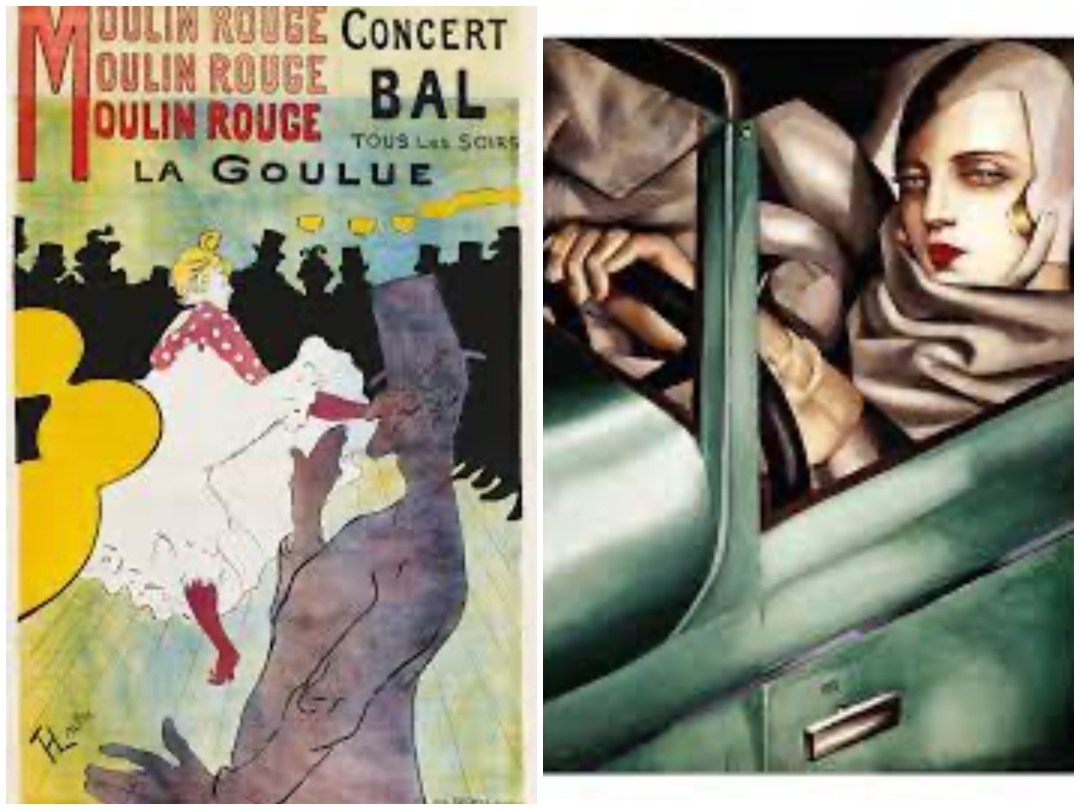
The late 19th and early 20th centuries witnessed significant changes in art movements and cultural contexts. Henri de Toulouse-Lautrec‘s 1891 painting, “La Goulue,” and Tamara Lempicka‘s 1929 painting, “Autoportrait (Tamara in a Green Bugatti),” exemplify the transition from Post-Impressionism to Art Deco. This analysis aims to compare and contrast these two works, examining their artistic styles, subject matter, composition, and socio-cultural influences.
Toulouse-Lautrec’s “La Goulue” belongs to the Art Nouveau movement and demonstrates his affinity for the avant-garde. His bold use of colours, loose brushstrokes, and distorted proportions emphasize the vivacity and energy of the cabaret scene. Influenced by Japanese prints, Toulouse-Lautrec employs flat, decorative areas and a diagonal composition, drawing attention to the main figures in the foreground.
In contrast, Lempicka’s “Autoportrait” reflects the streamlined aesthetics of Art Deco. Her painting exhibits a precise and detailed approach, characterized by smooth lines and geometric forms. Inspired by the Cubist movement, Lempicka employs fragmented angles and overlapping planes, presenting a modern, multi-faceted self-portrait. The influence of the machine age is evident in the portrayal of the sleek green Bugatti car, symbolizing progress and luxury.
“La Goulue” depicts a cancan dancer, known by her stage name, engaging in lively entertainment at the Moulin Rouge. Toulouse-Lautrec captures the spirit of the Belle Époque, exploring themes of nightlife, pleasure, and the demimonde. His portrayal of the performer reveals a gritty reality beneath the glamorous exterior, offering a glimpse into the social dynamics and class struggles of the time.
In contrast, Lempicka’s “Autoportrait” presents a self-portrait of the artist in a luxurious car, embodying wealth, confidence, and independence. Lempicka’s depiction reflects the changing status of women in society during the 1920s. Her self-assured expression and fashion-forward attire challenge traditional gender roles, symbolizing the emergence of the “New Woman” in the modern era.
The composition of “La Goulue” is dynamic and asymmetrical, with diagonal lines and exaggerated figures dominating the canvas. Toulouse-Lautrec’s use of colour, particularly the vibrant reds and greens, heightens the atmosphere of the cabaret. The loose brushwork and impasto technique contribute to the sense of movement and spontaneity.
In contrast, “Autoportrait” employs a more balanced and structured composition. Lempicka’s precise lines and meticulously rendered details create a sense of order and control. The use of sharp angles and geometric forms, particularly in the car’s design, reflects the influence of Cubism and the sleekness of Art Deco design.
“La Goulue” captures the spirit of fin-de-siècle Paris, a period marked by rapid industrialization and the changing social landscape. Toulouse-Lautrec’s depiction of the Moulin Rouge and its performers reflects the growing fascination with entertainment, leisure, and the demimonde. The painting encapsulates the allure and excesses of the Belle Époque while shedding light on the lives of marginalized individuals.
“Autoportrait” embodies the modernist ideals of the 1920s. Lempicka’s self-portrait showcases the growing independence of women and their desire to break free from societal constraints. It reflects the changing roles and aspirations of women during the interwar period, celebrating their newfound agency and pursuit of pleasure.
The comparison of Toulouse-Lautrec’s “La Goulue” and Lempicka’s “Autoportrait (Tamara in a Green Bugatti)” highlights the evolution of artistic styles, subject matter, and socio-cultural influences from the late 19th to the early 20th century. While Toulouse-Lautrec’s work captures the vibrancy of Parisian nightlife and the struggles of the working class, Lempicka’s self-portrait embodies the changing status and aspirations of women in the modern era. These two paintings exemplify the transformative nature of art and its ability to reflect and shape the socio-cultural contexts in which they are created.
Discover more from The New Renaissance Mindset
Subscribe to get the latest posts sent to your email.
 The New Renaissance Mindset