
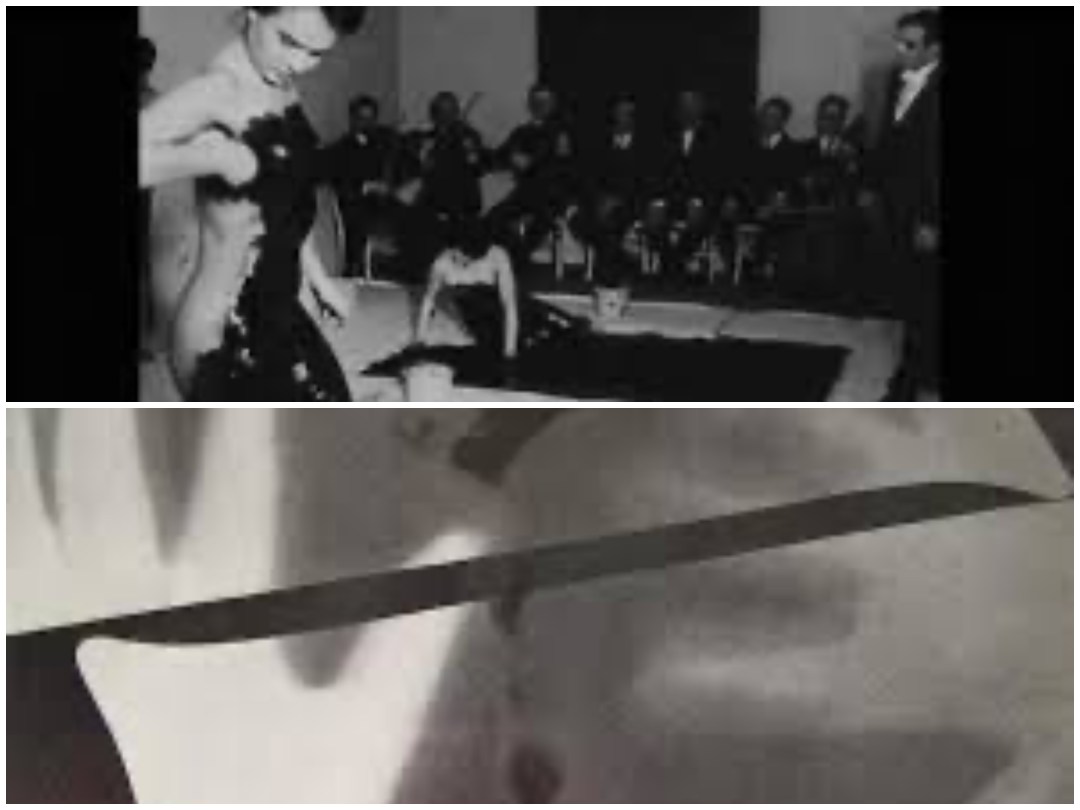
This analysis aims to compare and contrast two influential works of art from different periods: “The Anthropometries of the Blue Period” by Yves Klein, created in 1958, and “Rayograph” by Man Ray, captured in 1922. While these works differ significantly in terms of medium, context, and artistic intent, they both offer unique insights into the exploration of form, space, and human expression.
“The Anthropometries of the Blue Period” is a performance piece by Yves Klein, where the artist used nude female models as human brushes, applying blue paint to their bodies and directing them to make imprints on large canvases. This process resulted in abstract compositions that combined the human form with the artist’s signature blue hue. In contrast, “Rayograph” is a photogram created by Man Ray using the technique of placing objects directly onto light-sensitive paper and exposing them to light. This process produced a silhouette-like image without the use of a camera, showcasing the arrangement and interplay of various objects.
Yves Klein’s work in “The Anthropometries of the Blue Period” sought to transcend traditional painting techniques by incorporating the human body as a tool for artistic expression. By employing the female models as living brushes, Klein challenged conventional notions of authorship and explored the intersection of performance and painting. In contrast, Man Ray’s “Rayograph” was a pioneering exploration of the photogram technique, which blurred the boundaries between photography and fine art. Through the arrangement of objects in a darkroom, Ray created compositions that juxtaposed and abstracted everyday objects, encouraging viewers to question their perceptual understanding of reality.
In “The Anthropometries of the Blue Period,” Yves Klein’s use of the vibrant ultramarine blue as the primary colour evokes a sense of depth and otherworldliness. The human imprints on the canvas are both spontaneous and controlled, resulting in a rhythmic and dynamic composition. The blue monochrome also suggests a spiritual dimension, invoking the artist’s interest in transcendent experiences. In contrast, Man Ray’s “Rayograph” embraces a stark black-and-white aesthetic. The absence of colour directs attention to the interplay of light and shadow, creating a surreal and dreamlike atmosphere. The precise arrangement of objects adds a sense of mystery and invites viewers to interpret the symbolic potential of each element.
“The Anthropometries of the Blue Period” emerged in the post-World War II era, during a time when artists sought new forms of artistic expression. Klein’s work challenged the boundaries of conventional art, influenced by his interest in Eastern spirituality and philosophy. On the other hand, Man Ray’s “Rayograph” originated from the Dada and Surrealist movements of the early 20th century, characterized by their rejection of rationality and embrace of chance. The work reflects the avant-garde spirit of experimentation prevalent during that time.
Yves Klein’s “The Anthropometries of the Blue Period” and Man Ray’s “Rayograph” offer distinct artistic visions and techniques. While Klein’s performance piece explores the fusion of the human body and paint, Ray’s photogram technique highlights the play of objects and light. Both works challenge traditional artistic practices and encourage viewers to question their preconceived notions of art and reality. By examining these two influential pieces, we gain a deeper understanding of the evolution of artistic concepts, techniques, and their impact on cultural and historical contexts.
Discover more from The New Renaissance Mindset
Subscribe to get the latest posts sent to your email.
 The New Renaissance Mindset