
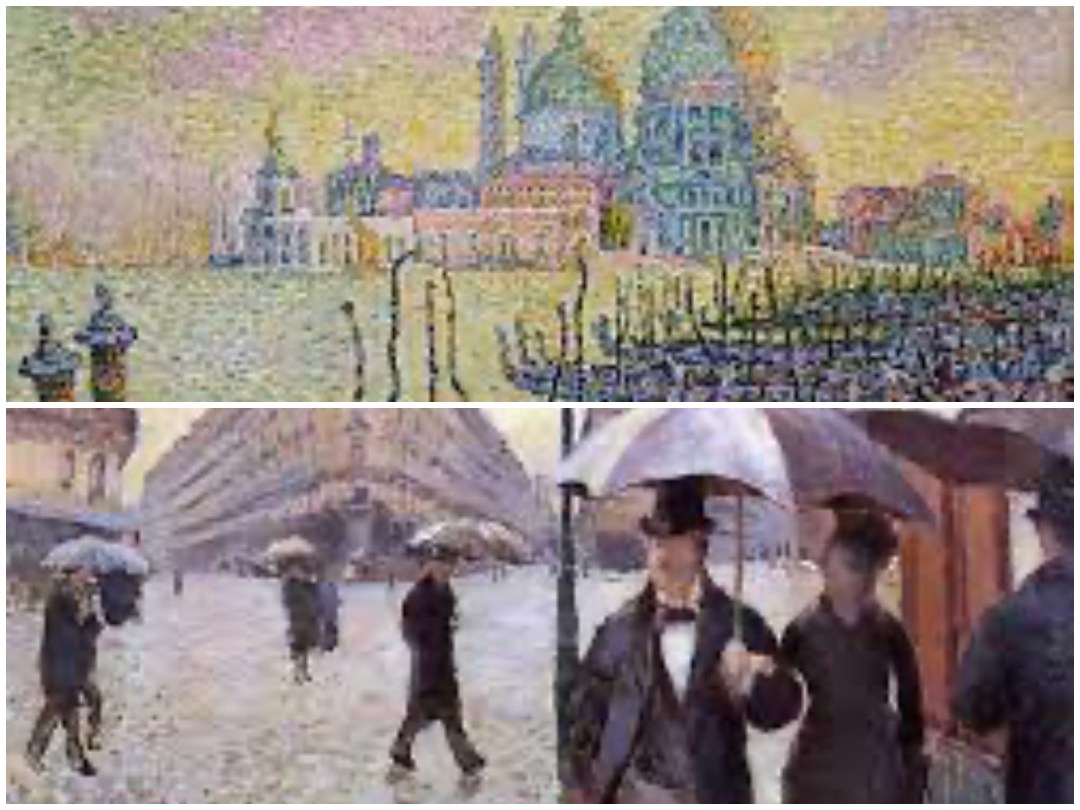
This analysis aims to compare and contrast two remarkable paintings from different time periods: “Entrance to the Grand Canal, Venice” by Paul Signac, completed in 1905, and “Paris Street Rainy Day” by Gustave Caillebotte, painted in 1877. By examining the artists’ use of colour, composition, and subject matter, we can gain insights into their unique artistic styles and the broader movements they were associated with.
Both paintings exhibit distinct approaches to colour and technique. Signac, a prominent Impressionist, employed the pointillist technique, applying small, distinct dots of colour to create a sense of vibrancy and optical blending. In “Entrance to the Grand Canal, Venice,” Signac’s meticulous application of dots of pure colour captures the luminosity of the Mediterranean sunlight, creating an almost mosaic-like effect.
In contrast, Caillebotte, associated with the Impressionist movement, utilizes a more direct and loose brushstroke style in “Paris Street Rainy Day.” The palette is predominantly composed of muted greys and blues, reflecting the gloomy atmosphere of a rainy Parisian street. Caillebotte’s use of colour suggests a focus on capturing the fleeting effects of light and weather, while also evoking a sense of melancholy.
The compositions of the two paintings also offer distinctive approaches. Signac’s “Entrance to the Grand Canal, Venice” presents a panoramic view of the Venetian waterfront, showcasing the bustling activity of boats, buildings, and figures. The scene is captured from a higher vantage point, offering a sense of expansiveness and depth. Signac’s emphasis on capturing the architectural details of the buildings and the interplay of light and shadow contributes to the overall dynamism of the composition.
On the other hand, Caillebotte’s “Paris Street Rainy Day” adopts a more intimate and tightly framed composition. The painting depicts a Parisian intersection with figures walking under umbrellas, reflecting the modern urban experience. Caillebotte’s use of a high horizon line and the inclusion of architectural elements like the wet cobblestones and the grid-like structure of the buildings lend a sense of order and balance to the composition. The figures are positioned diagonally, creating a subtle sense of movement and leading the viewer’s eye across the scene.
While both paintings depict urban scenes, they differ in terms of subject matter and cultural context. “Entrance to the Grand Canal, Venice” captures the timeless beauty and architectural grandeur of Venice, evoking a sense of nostalgia and romanticism. Signac’s fascination with the interplay of light and colour in the Mediterranean setting aligns with the broader interests of Post-Impressionist artists in exploring emotions and subjective experiences.
In contrast, “Paris Street Rainy Day” reflects Caillebotte’s interest in capturing the changing urban landscape of modern Paris during the Haussmannization project. The painting conveys a sense of the new urban lifestyle, highlighting the emergence of the bourgeoisie and the effects of rapid industrialization. The figures in their fashionable attire and the orderly arrangement of the cityscape embody the changing social dynamics of the time.
Through a comparative analysis of “Entrance to the Grand Canal, Venice” by Paul Signac and “Paris Street Rainy Day” by Gustave Caillebotte, we have explored the distinct approaches to colour, composition, and subject matter employed by the two artists. Signac’s use of pointillism and panoramic composition captures the vibrancy of the Mediterranean, while Caillebotte’s loose brushstrokes and intimate composition reflect the changing urban experience in Paris. Both paintings offer valuable insights into the artistic movements they represent and the social contexts in which they were created, contributing to the rich tapestry of art history.
Discover more from The New Renaissance Mindset
Subscribe to get the latest posts sent to your email.
 The New Renaissance Mindset