
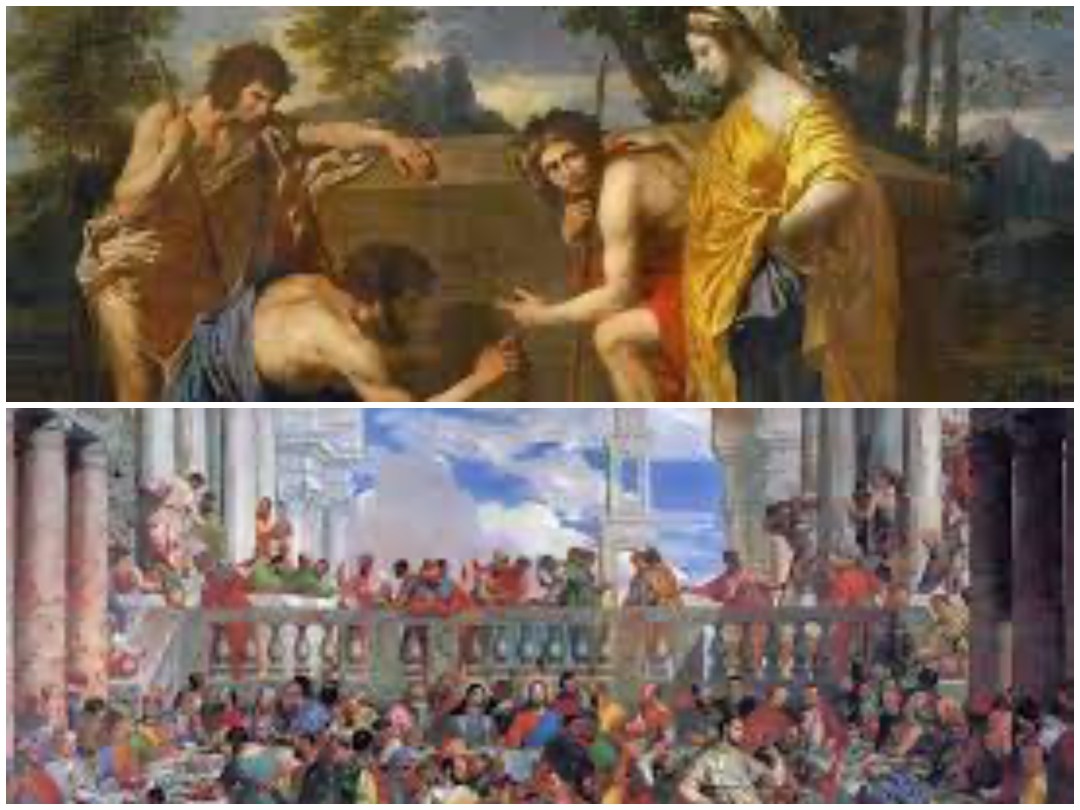
Nicolas Poussin‘s “Et in Arcadia Ego” (1638) and Paolo Veronese‘s “The Wedding at Cana” (1563) are two iconic paintings circa the Classical (or Baroque) and Mannerist (or Renaissance) periods (depending on who wrote the history), respectively. Both works showcase distinct artistic styles, subject matter, and narratives. This analysis aims to compare and contrast these two masterpieces, examining their composition, use of colour, symbolism, and overall impact.
Poussin’s “Et in Arcadia Ego” depicts a group of shepherds gathered around a tomb, examining an inscription that translates to “Even in Arcadia, I exist.” The painting explores the theme of mortality and the inevitability of death, inviting contemplation on the transient nature of life. In contrast, Veronese’s “The Wedding at Cana” portrays the biblical account of Jesus turning water into wine at a wedding feast. The narrative focuses on the celebration and abundance associated with this miracle, emphasizing themes of joy, divine intervention, and the power of faith.
Poussin’s painting exhibits a balanced and symmetrical composition. The figures are arranged in a pyramidal structure, with the tomb at the centre, creating a sense of stability and order. The landscape behind them recedes into the distance, enhancing the illusion of depth. In contrast, Veronese’s composition is characterized by a dynamic and crowded scene. The figures are dispersed across the canvas, creating a sense of movement and energy. The architecture of the grand hall forms a backdrop, providing a framework for the various groups of people and activities.
Poussin’s use of colour is more restrained and subdued. The painting features a predominantly earthy palette, with muted tones and a limited range of hues. This choice contributes to the somber mood of the scene. In “The Wedding at Cana,” Veronese employs a vibrant and rich colour palette, with a wide array of hues. The colours are more intense, creating a sense of opulence and grandeur. Veronese’s skillful use of light and shadow enhances the three-dimensional quality of the figures and adds a sense of drama to the scene.
Poussin’s painting contains symbolic elements that invite interpretation. The tomb represents mortality, while the inscription alludes to the presence of death even in idyllic settings. The shepherds, traditionally associated with innocence and simplicity, contemplate the inevitability of their own mortality. In Veronese’s work, the focus is on the miracle of turning water into wine, symbolizing the transformative power of faith and the divine intervention of Jesus. The lavish setting and abundance of food and drink convey themes of celebration, hospitality, and the joyful nature of the occasion.
“Et in Arcadia Ego” is considered a quintessential work of Poussin’s mature style, reflecting his classical approach and intellectual engagement. The painting’s introspective and philosophical nature makes it an emblematic example of Baroque art. On the other hand, “The Wedding at Cana” is celebrated for its grandeur, complex composition, and Veronese’s mastery of colour and perspective. It exemplifies the opulence and theatricality of Renaissance art, displaying Veronese’s ability to capture intricate details and convey a sense of spectacle.
Despite their temporal and stylistic differences, Poussin’s “Et in Arcadia Ego” and Veronese’s “The Wedding at Cana” share a commonality in their artistic excellence and ability to evoke emotional and intellectual responses. Both paintings demonstrate the mastery of their respective artists and embody the unique characteristics of their historical periods. Poussin’s work invites introspection and contemplation, while Veronese’s painting captures the grandeur and joy associated with a biblical miracle. Together, they stand as testaments to the enduring power of art to transcend time and communicate profound human experiences.
Discover more from The New Renaissance Mindset
Subscribe to get the latest posts sent to your email.
 The New Renaissance Mindset