
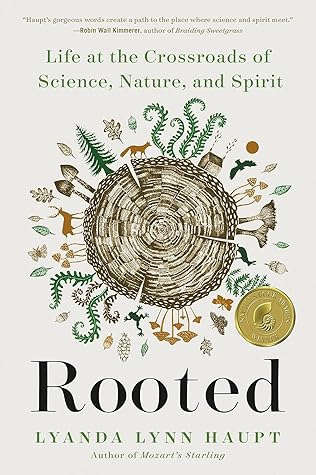
Lyanda Lynn Haupt’s Rooted: Life at the Crossroads of Science, Nature, and Spirit is best read not as a conventional nature book, but as a work of ecological devotion. The publisher frames it as a meditation on how “science, nature, and spirit” meet, and that is exactly its achievement: Haupt refuses the old split between data and wonder, insisting that the natural world is not merely observed but encountered, inhabited, and ethically answered. In that sense, the book belongs to the lineage of Rachel Carson, Mary Oliver, and the newer wave of ecologically minded prose that treats attention itself as a form of responsibility.
What makes the book compelling is its argument that belonging is not sentimental, but embodied. Haupt writes that “our bodies, minds, and spirits stand in ancient communion with the soil,” a sentence that compresses the book’s central claim into one luminous image. The phrase “ancient communion” is especially revealing: it suggests that rootedness is not a lifestyle choice but an inheritance, something old in us, and older than us. Her prose repeatedly turns ecology into kinship, and kinship into a spiritual practice.
That spiritual practice is grounded in a critique of modern distance. Haupt notes that modern science has given us immense knowledge, yet not always “an intimate presence within a meaningful universe,” because we have come to see reality as “a collection of objects” rather than “a communion of subjects.” This is one of the book’s strongest intellectual moves. She does not reject science; she rebukes reductionism. Her concern is not whether we know enough facts, but whether our way of knowing has become too detached to sustain reverence.
Her prose is at its richest when it joins insight to tenderness. A line such as “hope is not a remedy … but a companion” resists easy optimism while still protecting the possibility of meaning. Likewise, her insistence that “brokenness and beauty sometimes intertwine” gives the book its emotional maturity. Haupt is not offering pastoral escapism. She understands grief, anxiety, and ecological crisis; what she offers instead is a disciplined kind of hope, one that can live alongside loss without denying it.
One of the book’s most distinctive qualities is its sacramental imagination. Haupt says something can be “made sacred by the attention we grant it,” and that sentence unlocks the whole text. Attention, in her hands, is not passive looking but an act of transformation. To attend to a place, a creature, or a path is to enter relation with it. That is why the book so often returns to walking, wandering, and the refusal of rigid routes: “This way, this way…” becomes both invitation and philosophy, a reminder that the unscripted path may reveal forms of knowledge unavailable to the efficient and the planned.
As a literary work, Rooted is strongest when its lyricism is allowed to carry its ideas. At times the book can feel more incantatory than argumentative, but that is also part of its power. Haupt is not trying to win a debate so much as to re-pattern the reader’s perception. Her sentences ask us to slow down, to notice, to recover a vocabulary for wonder that has not been embarrassed into silence. The result is a book that feels both intimate and prophetic: intimate because it begins with the body, the walk, the daily encounter; prophetic because it imagines a more generous way of being alive on the earth.
In the end, Rooted is an eloquent argument that our relation to the natural world is not optional or ornamental. It is formative. Haupt’s greatest strength is her ability to make that claim feel at once intellectually serious and spiritually nourishing. For readers drawn to nature writing that is contemplative rather than merely descriptive, Rooted offers a rich, searching, and quietly transformational experience.
Discover more from The New Renaissance Mindset
Subscribe to get the latest posts sent to your email.
 The New Renaissance Mindset