
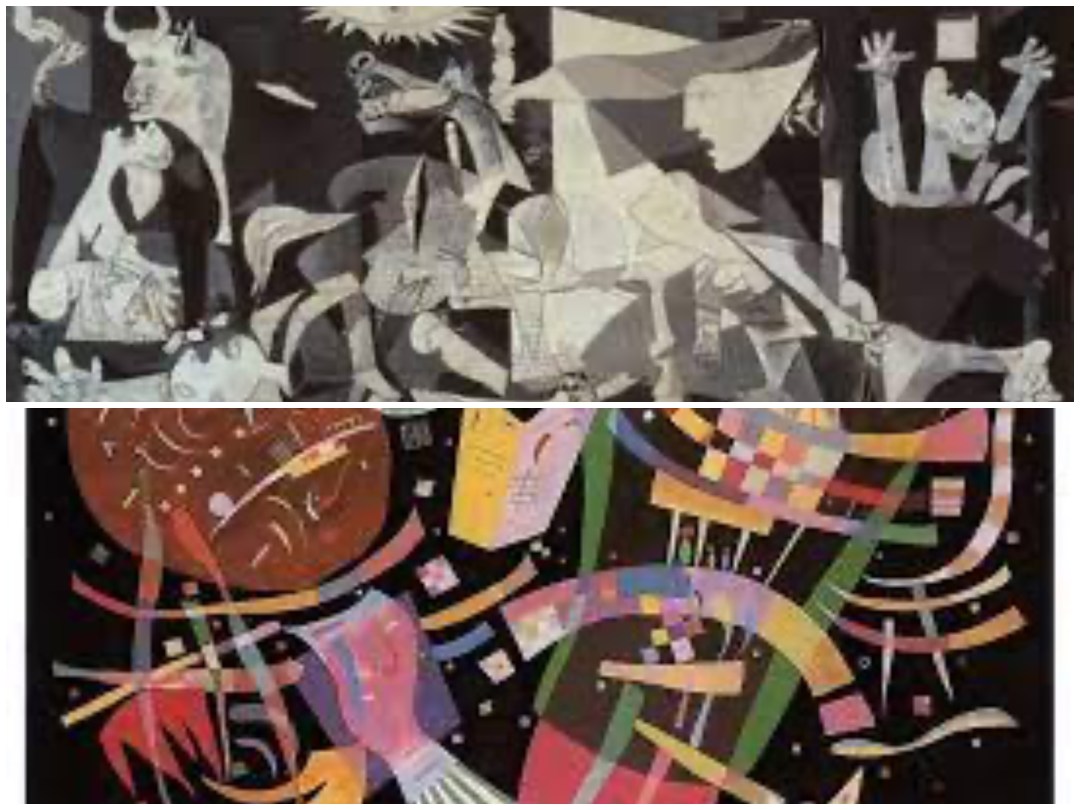
he art world of the early 20th century witnessed a surge of creative expression in response to the political and social upheaval of the time. Artists sought to convey their emotions, beliefs, and observations through their work, often utilizing abstract forms to depict complex ideas. This paper aims to compare and contrast two significant artworks from this period: Guernica (1937) by Pablo Picasso and Composition X (1939) by Wassily Kandinsky. Despite their stylistic differences, both paintings reflect the turmoil and suffering of their respective eras, albeit in distinct ways.
Guernica and Composition X were created during a period overshadowed by political turmoil and war. Guernica was a response to the devastating bombing of the town of Guernica during the Spanish Civil War, while Composition X emerged on the eve of World War II. These historical events profoundly influenced the artistic intentions and thematic content of both paintings.
Guernica, a monumental black-and-white canvas, presents a fragmented composition, with distorted and dismembered human and animal forms. The use of Cubist techniques, such as fractured space and multiple viewpoints, accentuates the chaotic atmosphere. In contrast, Composition X is characterized by vibrant colours, intricate geometric shapes, and a sense of movement. Kandinsky’s abstract expressionist style, influenced by his background in music, aims to evoke emotional responses through non-representational forms.
Picasso’s Guernica is a powerful anti-war statement, depicting the horrors of the conflict and the suffering endured by innocent civilians. The painting is rich in symbolism, with motifs like the bull, horse, and weeping women, representing various aspects of the war’s devastation, as well as Picasso’s psyche. The absence of colour intensifies the emotional impact and conveys a sense of mourning and despair. In contrast, Kandinsky’s Composition X does not adhere to representational symbolism. Instead, it embraces a more universal language of abstract forms, aiming to evoke a personal and emotional response from the viewer through colours, shapes, and their interaction.
Guernica elicits a visceral emotional response through its raw and explicit depiction of human suffering and violence. The use of angular and distorted figures intensifies the sense of anguish and chaos. In Composition X, Kandinsky’s vibrant palette and dynamic composition create an energetic and uplifting atmosphere. The interplay of colours and forms invites the viewer to engage emotionally and intellectually, stimulating contemplation and reflection.
Picasso’s Guernica serves as a political statement and condemnation of war, expressing the artist’s empathy for the victims and his desire for social change. By contrast, Kandinsky’s Composition X seeks to transcend specific political or social narratives, aiming for a more spiritual and abstract expression of the human experience. Kandinsky believed that art had the power to communicate beyond language and rational thought, evoking a deeper understanding of the world.
In summary, Guernica and Composition X exemplify the diverse approaches of two influential artists during a tumultuous period in history. Picasso’s Guernica addresses the atrocities of war through powerful symbolism and emotional intensity, while Kandinsky’s Composition X explores the universal language of abstract forms and colours. Both paintings convey profound messages, reflecting the artists’ responses to the socio-political circumstances of their time and providing a lasting testament to the power of art as a means of expression and reflection.
Discover more from The New Renaissance Mindset
Subscribe to get the latest posts sent to your email.
 The New Renaissance Mindset