
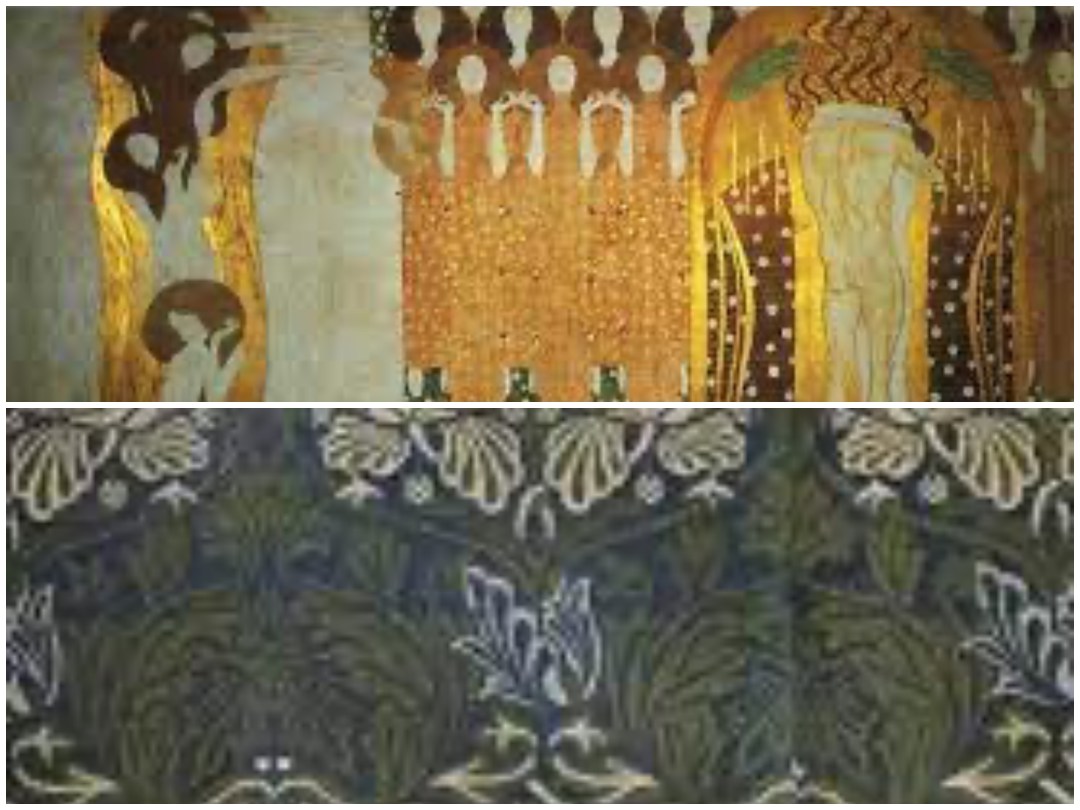
The 1901 artwork “Beethoven Frieze” by Gustav Klimt and the 1876 artwork “Tulip and Rose” by Morris & Co are both exemplary pieces from the turn of the 19th century, showcasing the diverse artistic expressions of their respective periods. This comparative analysis will explore the thematic and stylistic elements of these works, examining their historical context, symbolism, and artistic techniques.
“Beethoven Frieze” is a monumental piece commissioned for the 14th Vienna Secessionist Exhibition, paying homage to the composer Ludwig van Beethoven. It depicts a series of interconnected scenes symbolizing human struggles and aspirations, exploring themes such as love, desire, and the pursuit of happiness. On the other hand, “Tulip and Rose” is a textile design created by Morris & Co, reflecting the Victorian fascination with natural motifs. It features a symmetrical arrangement of tulips and roses, imbuing the work with a sense of natural beauty and harmony.
Klimt’s “Beethoven Frieze” employs rich symbolism and allegory to convey its narrative. The central figure, the “Kiss of the Muse,” represents inspiration and artistic creation, surrounded by diverse characters symbolizing human desires and the quest for fulfillment. The “Gorgon” and “Typhoeus” represent oppressive forces, while the “Knight” symbolizes the hero’s journey and triumph over adversity. In contrast, “Tulip and Rose” by Morris & Co utilizes floral motifs to represent the ephemeral nature of life and the transience of beauty. The tulips symbolize perfect love, while roses signify love’s fleeting nature.
Klimt’s “Beethoven Frieze” showcases the artist’s distinctive Art Nouveau style. He combines elements of Byzantine mosaics, Egyptian friezes, and Japanese prints to create a visually opulent composition. The work features intricate gold leaf patterns, expressive lines, and vivid colours, enveloping the viewer in a mesmerizing tapestry of shapes and forms. In contrast, Morris & Co’s “Tulip and Rose” epitomizes the Arts and Crafts Movement, characterized by a return to traditional craftsmanship. The wool curtain utilizes intricate weaving techniques and a restrained colour palette, emphasizing the meticulous attention to detail and the celebration of natural beauty.
“Beethoven Frieze” emerged during a period of cultural and artistic transformation in Vienna, where the Secessionist movement sought to break away from conservative academic traditions. Klimt’s work embodies the spirit of rebellion and artistic freedom, challenging societal norms and pushing the boundaries of artistic expression. On the other hand, “Tulip and Rose” reflects the Victorian era’s renewed interest in traditional craftsmanship and the rejection of mass-produced goods. Morris & Co sought to revive the value of handcrafted art and elevate everyday objects into works of beauty.
In conclusion, the comparative analysis of Gustav Klimt’s “Beethoven Frieze” and Morris & Co’s “Tulip and Rose” reveals the distinct thematic, symbolic, and stylistic elements of these artworks. While Klimt’s work explores human desires and aspirations through rich symbolism and elaborate Art Nouveau techniques, Morris & Co’s textile design embraces the beauty of nature and the ideals of the Arts and Crafts Movement. These works exemplify the artistic innovations and historical contexts of their respective periods, leaving an indelible mark on the art world and inspiring future generations of artists.
Discover more from The New Renaissance Mindset
Subscribe to get the latest posts sent to your email.
 The New Renaissance Mindset