
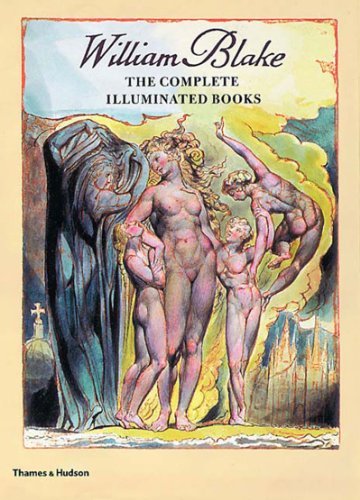
William Blake’s The Complete Illuminated Books is not merely a compilation of poetry and artwork; it is a profound fusion of word and image, embodying the Romantic ethos while forging a genre-defying expression of philosophical, theological, and artistic vision. This collection is an unparalleled window into the mind of one of the most enigmatic and revolutionary figures in literary and artistic history.
The Art of Visionary Fusion
Blake’s illuminated books transcend the traditional boundaries of literary form. His intricate engravings and vibrant watercolors integrate seamlessly with his poetry, creating an immersive experience that forces the reader to engage on multiple sensory levels. The visual elements are not mere embellishments but are essential to understanding the text. Works like Songs of Innocence and of Experience are exemplary in this regard, with the interplay between image and verse underscoring themes of innocence, corruption, and redemption.
The book itself feels like an invocation of a sacred text—a deliberate mirroring of the illuminated manuscripts of medieval tradition, yet with an anarchic spirit that subverts the religious orthodoxy they once upheld. Blake reclaims illumination as a medium for individual revelation and dissent.
Themes of Mysticism and Revolution
Blake’s works are imbued with a profound mysticism, grappling with the eternal dualities of existence: innocence and experience, materialism and spirituality, order and chaos. His mythology, articulated in dense and enigmatic texts such as The Marriage of Heaven and Hell and Jerusalem, is both a cosmology and a critique of contemporary society. Blake envisions a universe where human imagination—the “Divine Vision”—is both the source of salvation and the battleground for oppressive forces.
One of the collection’s most radical aspects is its interrogation of institutionalized religion and authority. In The Marriage of Heaven and Hell, Blake provocatively declares that “Without Contraries is no progression,” reframing good and evil not as moral absolutes but as dynamic forces essential for creative and spiritual growth. Such proclamations challenge conventional moral binaries and resonate deeply with postmodern sensibilities.
Craftsmanship and Innovation
The meticulous craftsmanship of Blake’s illuminated books is breathtaking. Blake developed his own technique of relief etching, a painstaking process that combined artistry with technical ingenuity. His ability to sustain such a level of precision while producing works of staggering originality is a testament to his unwavering vision. The result is a body of work that remains as compelling and perplexing today as it was in his lifetime.
Blake’s diction oscillates between simplicity and profound complexity. Poems like “The Tyger” captivate with their rhythmic and linguistic clarity while embedding layers of philosophical inquiry. Conversely, works like Jerusalem require a deep commitment to decoding their dense allegories, rewarding the reader with revelations about human potential and the nature of existence.
The Modern Reader’s Perspective
To a contemporary audience, The Complete Illuminated Books offers a challenge: to engage with a text that resists easy categorization and demands active participation. It is not a book to be consumed; it is one to be wrestled with, explored, and reimagined. The sheer density of Blake’s mythology and the unorthodox marriage of text and art may alienate some, but for those willing to invest the effort, the reward is immense. Blake’s vision of liberation through imagination remains strikingly relevant in an age increasingly dominated by conformity and commodification.
The Complete Illuminated Books is not simply a collection but a testament to the possibilities of human creativity. Blake’s work, with its prophetic voice and transcendent artistry, continues to challenge and inspire, offering new interpretations with each reading. For literary scholars, artists, and seekers of spiritual truth, this book is an inexhaustible wellspring. William Blake reminds us, in every illuminated page, that “the imagination is not a state: it is the human existence itself.”
This collection is a masterpiece of literature and art—a work that deserves not only to be read but to be lived with, contemplated, and cherished.
Discover more from The New Renaissance Mindset
Subscribe to get the latest posts sent to your email.
 The New Renaissance Mindset
It sounds like a great work, like Dante’s Inferno
LikeLike