
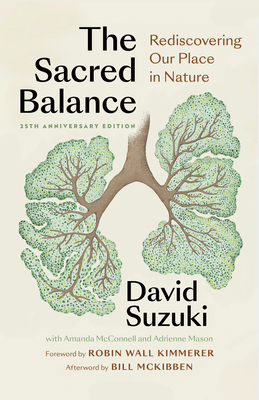
David Suzuki’s The Sacred Balance returns in a thoughtful 25th-anniversary edition that reads less like a retread and more like a conversation re-opened across decades. This edition—issued by Greystone with a new foreword by Robin Wall Kimmerer and an afterword by Bill McKibben—pairs Suzuki’s lucid synthesis of ecology and ethics with two contemporary interlocutors whose voices clarify how his project sits inside current debates about Indigenous knowledge, climate urgency, and the moral stakes of science.
At its best, The Sacred Balance is a hybrid: part natural history, part systems analysis, part moral treatise. Suzuki writes with the authority of a scientist (his career as a geneticist and public educator informs the book’s empirical grounding) and with the moral cadence of a public intellectual who knows how to speak to non-specialists. That dual identity—scientist and storyteller—gives the book its principal virtue: Suzuki can move from the chemistry of photosynthesis to the ethics of land stewardship with a clarity that rarely lapses into either jargon or sanctimony.
Formally, the book is shaped by an ecological imagination that insists on interdependence. Suzuki’s chapters read as deliberate zooms: molecules to organisms, organisms to ecosystems, ecosystems to human institutions. He rehearses science just enough to make the conceptual leaps available to a general reader, then pivots to philosophical and cultural implications—why we value nature, how economic habits erode resilience, and what it would mean to reorient political life around biological limits. The result is an argument built on pattern and scale rather than on polemic; his rhetorical strategy is to show how separation is an illusion born of habit rather than evidence. Those who prize a structural account of ecological crisis will find this approach clarifying and, often, urgent.
The anniversary edition’s added materials sharpen more than they merely commemorate. Robin Wall Kimmerer’s foreword—herself a writer and botanist who works at the intersection of Indigenous epistemologies and Western science—situates Suzuki’s voice within traditions he came to appreciate later in life; Bill McKibben’s afterword reads the book through the lens of contemporary climate activism. Together they update Suzuki’s frame: the ecological principles remain, but the stakes are newly explicit, and the book’s commitments to Indigenous knowledge are presented as necessary correctives rather than optional supplements.
A literary reader will also appreciate the author’s use of metaphor: he often turns to kinship language—balance, reciprocity, stewardship—which both humanizes and moralizes ecological relations. This is the book’s rhetorical strength and occasional vulnerability. The warmth of his metaphors invites broad readership and ethical imagination; at times those very metaphors risk simplifying contested political terrains into moral parables. Readers seeking a dense policy manual or a technocratic roadmap may desire more procedural specificity; Suzuki’s goal is different—he wants to alter the way we perceive and value the world, which is a prerequisite for any enduring policy change.
Critically, the book’s biggest contribution is ethical: it insists that scientific facts alone will not rearrange behaviour. Knowledge must be embedded in narrative and practice. For teachers, community organizers, and engaged citizens, The Sacred Balance remains an effective primer in how to cultivate those narratives. The anniversary updates make that primer more candid about failure and more insistent about urgency: what once could be framed as hopeful stewardship now reads, appropriately, as a call to urgent and systemic transformation.
If the book has limits, they are instructive. Suzuki sometimes writes as if civic will is primarily a matter of information and moral persuasion; the structural power of corporations, the inertia of political institutions, and the complexities of environmental justice receive less procedural attention than their moral importance would suggest. Yet the new edition’s attention to Indigenous voices and to activists’ perspectives goes some way toward remedying this by insisting that knowledge must be accompanied by power-sharing and by listening to those already defending the land.
The 25th-anniversary The Sacred Balance is both a historical document of ecological thought and a living book. It rewards readers who want an elegiac yet practical meditation on how to re-embed humanity within nature’s ledger. For scholars of environmental literature it remains a model of how scientific exposition can be woven into ethical argument; for activists and educators it remains a readable and moral handbook for rethinking our place in the world. If you return to Suzuki now, you will find not only a persistent clarity of argument but a renewed insistence that to survive we must first learn to see differently.
Recommended for readers interested in ecological thought, environmental ethics, and the civic possibilities of scientific writing.
Discover more from The New Renaissance Mindset
Subscribe to get the latest posts sent to your email.
 The New Renaissance Mindset
This is a thoughtful, elegant, and deeply informed appreciation of The Sacred Balance. Your writing carries intellectual clarity without losing warmth, and it honors Suzuki’s work while engaging it critically rather than reverentially. I especially admire how you frame the anniversary edition as a “conversation re-opened across decades” — that insight alone sets a reflective, scholarly tone.
Your balance between literary analysis, ethical reflection, and contextual critique mirrors the very balance Suzuki argues for. The way you weave in Kimmerer and McKibben strengthens the piece, showing how the book lives within evolving ecological and moral conversations. It reads as both a serious review and an invitation to think differently.
A nuanced, generous, and persuasive appreciation — the kind that makes a reader want not just to read the book, but to re-read it with new eyes.
LikeLiked by 1 person
Thank you Mr. Verma.
Suzuki’s is a voice I hear clearly in my head. I grew up on watching him on The Nature of Things, reading his talks and papers in university, and following his views whenever they came to me. I do admire the man and his mind-heart, for showing what humanity can be.
His writings and speaking always feel like the voice of compassion and reason I strive for in my thought sharing.
LikeLiked by 1 person