
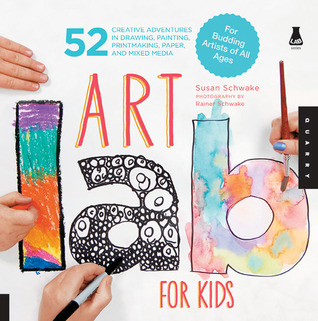
Susan Schwake’s approach in this compact manual is quietly ambitious: deliver fine-art experiences in short, repeatable labs so that a parent, teacher, or small-group leader can run a semester’s worth of explorations with minimal prep and maximum creative payoff. The book is organized as six units (Drawing; Painting; Printmaking; Paper; Mixed Media; plus usage/how-to material) … Continue reading The Adaptable Educator’s Book Review – Art Lab for Kids: 52 Creative Adventures in Drawing, Painting, Printmaking, Paper, and Mixed Media by Susan Schwake
Revisionist Pedagogy – The Case for Media Literacy in Elementary Education: An Evidence-Based Argument
In an era dominated by digital media, media and information literacy—the competencies to access, analyze, evaluate, create, and act with information across media—should be treated as a foundational skill alongside reading and numeracy. International frameworks frame media literacy as a teachable, scaffoldable competency that can and should be embedded into core curricula rather than treated … Continue reading Revisionist Pedagogy – The Case for Media Literacy in Elementary Education: An Evidence-Based Argument
Revisionist Pedagogy – Unveiling Power: How Critical Theory Reshapes Literature, Culture, and Society, v.2
Abstract. Critical Theory, originating with the Frankfurt School, offers educators analytic tools that move students beyond surface reading to interrogate how texts and media reproduce power. This article argues that integrating core critical concepts—ideology critique, the culture industry, reification, and reflexivity—into curriculum design produces measurable gains in critical literacy, civic agency, and equity-centred pedagogy. I … Continue reading Revisionist Pedagogy – Unveiling Power: How Critical Theory Reshapes Literature, Culture, and Society, v.2
Revisionist Pedagogy – Transforming Education: How Critical Theory Can Revolutionize the IB-MYP Experience
Critical theory offers a powerful framework for aligning the International Baccalaureate Middle Years Programme (IB‑MYP) with democratic education, social justice, and critical inquiry. This article synthesizes foundational scholarship in critical pedagogy with implementation‑ready strategies for curriculum design, assessment, governance, and professional development. A phased pilot model, performance rubrics, and interdisciplinary planning structures are proposed to support sustainable reform. The article argues that when critical theory is operationalized through concrete classroom practices and measurable outcomes, the IB‑MYP can become a transformative space for cultivating critically conscious and socially engaged learners.
Revisionist Pedagogy – Revolutionizing Special Education: How Critical Theory Transforms SEND Teaching Methods for Equity and Empowerment
Abstract Critical theory and critical pedagogy offer conceptual tools that, when translated into operational practices, can materially improve Special Educational Needs and Disabilities (SEND) provision. This article synthesizes scholarly and practitioner literatures on Universal Design for Learning (UDL), co-teaching, student participation in Individualized Education Program (IEP) processes, Goal Attainment Scaling (GAS), anti-ableism professional development, and … Continue reading Revisionist Pedagogy – Revolutionizing Special Education: How Critical Theory Transforms SEND Teaching Methods for Equity and Empowerment
Revisionist Pedagogy – Empowering Tomorrow’s Change-makers: Applying Critical Theory in Primary Education, v2
Critical theory — here understood as a set of tools for noticing power, asking who benefits from a given idea, and imagining fairer alternatives — can be translated into developmentally appropriate practice in primary schools. When paired with teacher supports, intentional assessment, and community engagement, it cultivates children who are observant, empathetic, and ready to … Continue reading Revisionist Pedagogy – Empowering Tomorrow’s Change-makers: Applying Critical Theory in Primary Education, v2
Revisionist Pedagogy – Empowering Educators: Revolutionizing Teacher Training with Critical Theory
Critical theory equips teacher education with a principled, practice-oriented framework for preparing educators who can recognize and disrupt inequitable power structures in schools and society. When paired with culturally relevant pedagogy and sustained, practice-based professional learning, critical theory does more than motivate ethical teaching: it produces measurable shifts in instructional practice, curriculum design, and teacher … Continue reading Revisionist Pedagogy – Empowering Educators: Revolutionizing Teacher Training with Critical Theory
Revisionist Pedagogy – Awakening Wisdom: How Critical Theory and Indigenous Pedagogies Co-Create Inclusive Education
Critical theory offers powerful tools for interrogating how knowledge, power, and identity operate within educational systems. Its emphasis on social justice, historical inequities, and the dismantling of dominant paradigms makes it a productive—though not sufficient—framework for supporting the integration of Indigenous pedagogies in contemporary education (Apple, 2013; Freire, 1970). When combined with de-colonial commitments and … Continue reading Revisionist Pedagogy – Awakening Wisdom: How Critical Theory and Indigenous Pedagogies Co-Create Inclusive Education
Revisionist Pedagogy – Computational Creativity in Schools: A Practical, Ethical, and Pedagogical Rewrite. (a.k.a. Exploring Computational Creativity: Bridging Art and Technology, v.2)
Introduction As digital technologies reshape art and learning, Computational Creativity—the use of algorithmic systems to generate, augment, or inform creative work—is now central to contemporary arts education. This essay defines the field, gives concrete classroom-ready applications, addresses operational ethics, and proposes assessment and policy steps so schools can thoughtfully adopt computational practices without sacrificing equity, … Continue reading Revisionist Pedagogy – Computational Creativity in Schools: A Practical, Ethical, and Pedagogical Rewrite. (a.k.a. Exploring Computational Creativity: Bridging Art and Technology, v.2)
Revisionist Pedagogy – Exploring the Nexus of Augmented Reality and Virtual Reality in Visual Arts Education, v.2
Introduction Traditional studio practices remain indispensable for learning material, mark-making, and craft. Yet the affordances of Augmented Reality (AR) and Virtual Reality (VR) extend the studio in ways that address particular limitations of time, scale, and sensory modality. When integrated with clear learning goals, scaffolded pedagogy, and attention to equity and ethics, AR/VR can deepen … Continue reading Revisionist Pedagogy – Exploring the Nexus of Augmented Reality and Virtual Reality in Visual Arts Education, v.2
 The New Renaissance Mindset